Thermofluids (thermofluids-ai999x)
Thermofluids covers fluid statics and dynamics, pipe flow, boundary layers, aerodynamics, heat conduction, convection and radiation, heat exchangers, thermodynamic cycles, psychrometrics and combustion: 106 calculations in 22 topics, each with its formula, its steps and its units, and a plain reason instead of a number when an input is missing or out of range. One compiled engine, four ways to use it: the desktop app, the command line, the browser and Python. Everything runs on your own computer, offline.
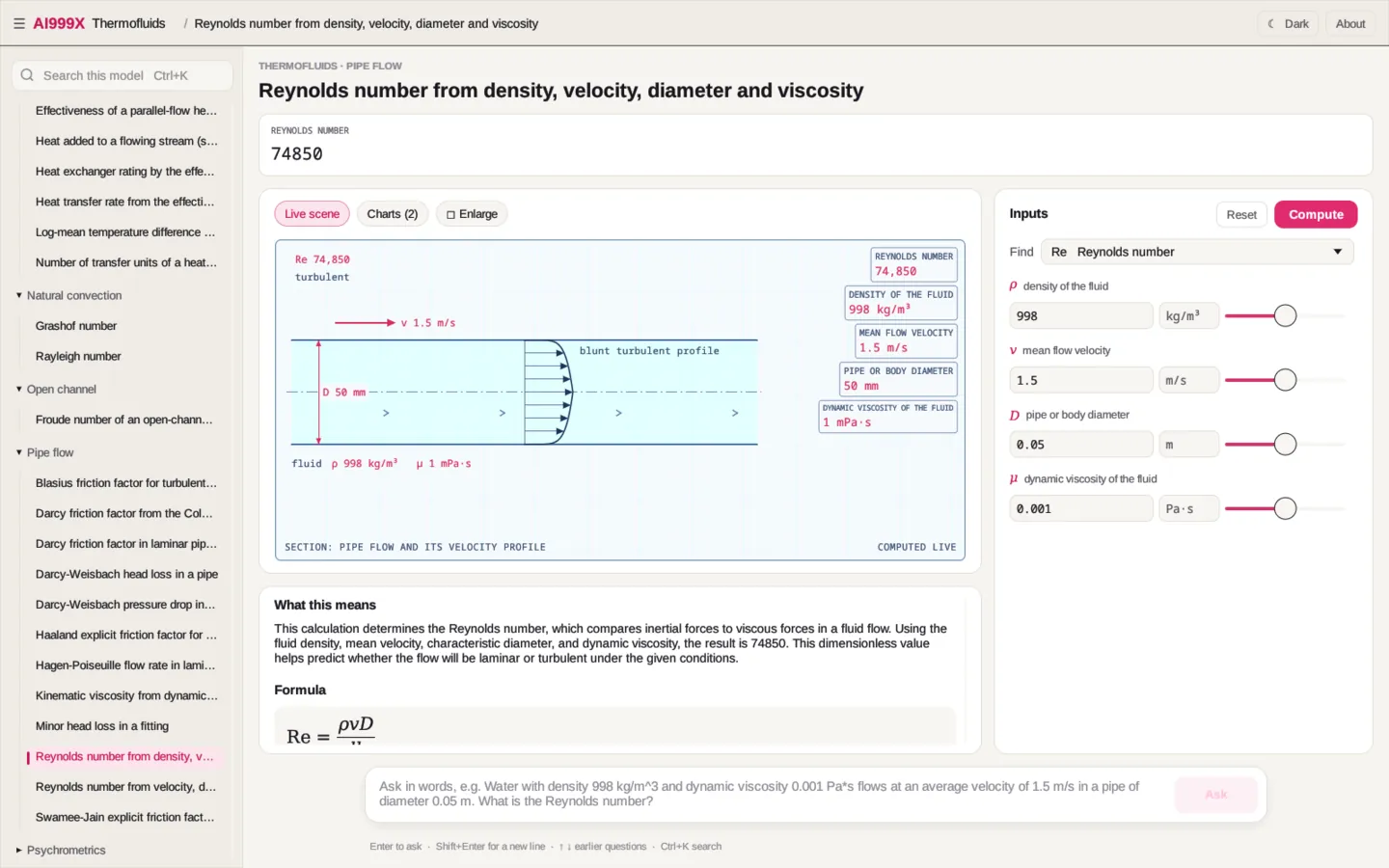
Four ways to use it
| Desktop app (Windows, Linux) | Windows · Linux |
Command line thermofluids (Windows, Linux) | Windows · Linux |
| Browser (any device) | Try it on the model page |
| Python 3.10+ | pip install thermofluids-ai999x: on Windows and Linux (x86-64) pip installs the same compiled engine; on other systems (macOS, ARM) it installs a pure-Python build that gives the same answers |
See it
From the Thermofluids desktop app: every scene and chart is drawn from the computed answer.
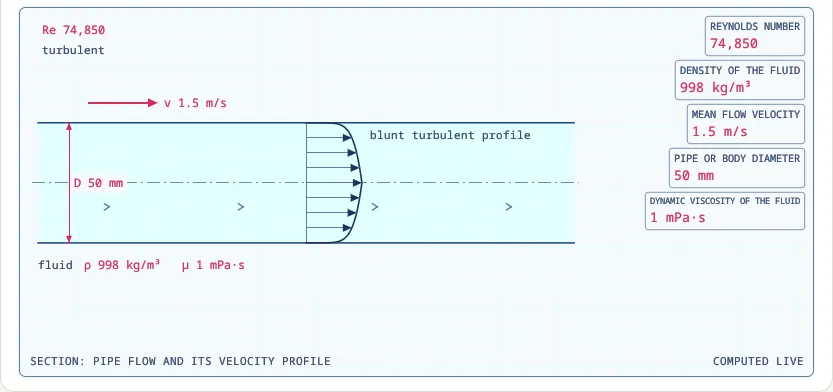 Reynolds number from density, velocity, diameter and viscosity | 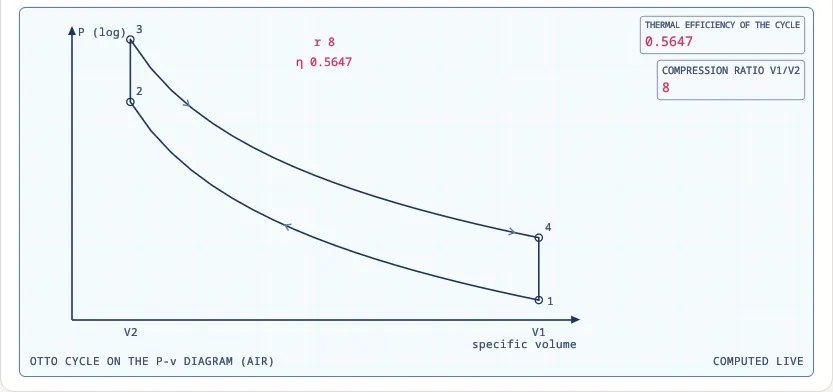 Thermal efficiency of the air-standard Otto cycle |
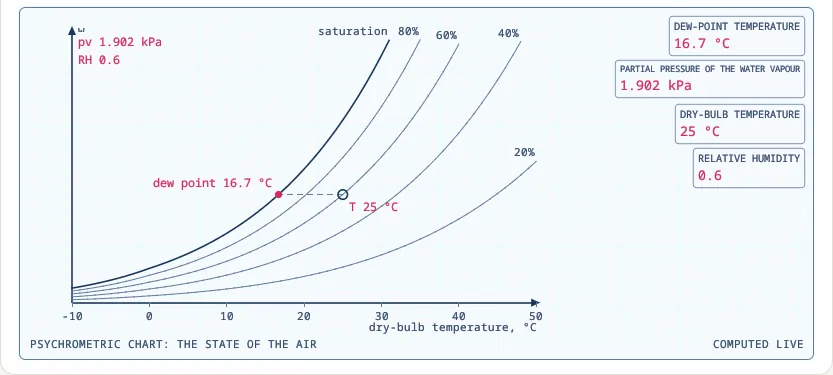 Dew-point temperature from dry-bulb temperature and relative humidity | 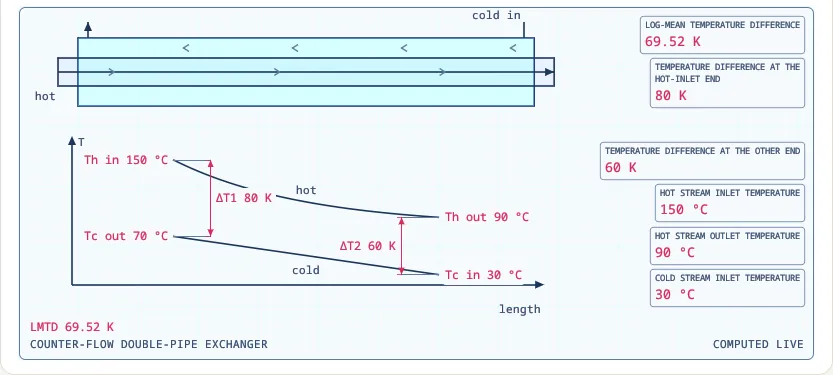 Log-mean temperature difference of a heat exchanger |
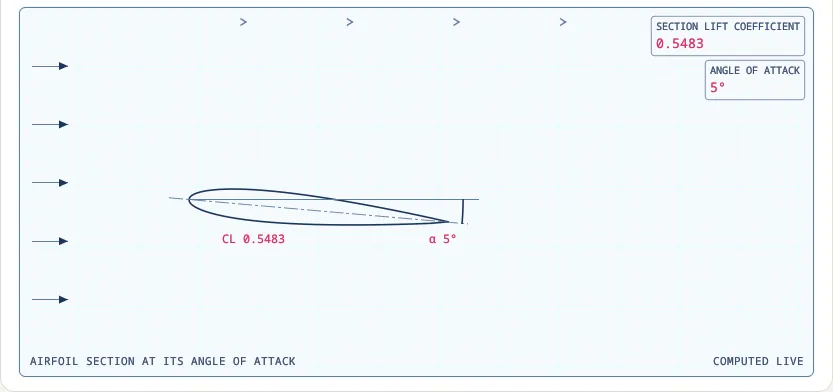 Lift coefficient of a thin symmetric airfoil | 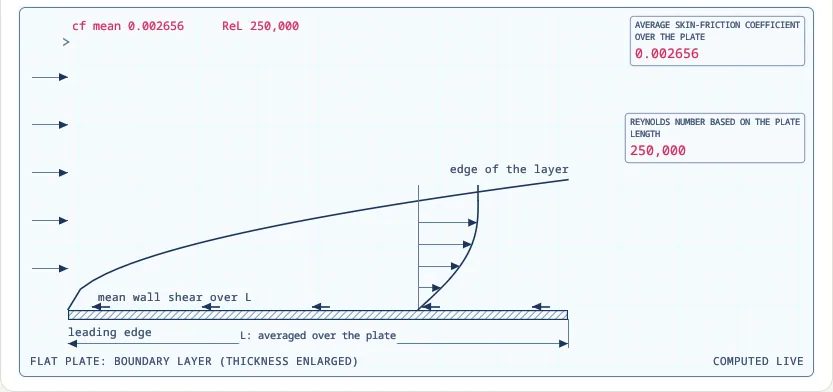 Average skin-friction coefficient of a laminar flat plate |
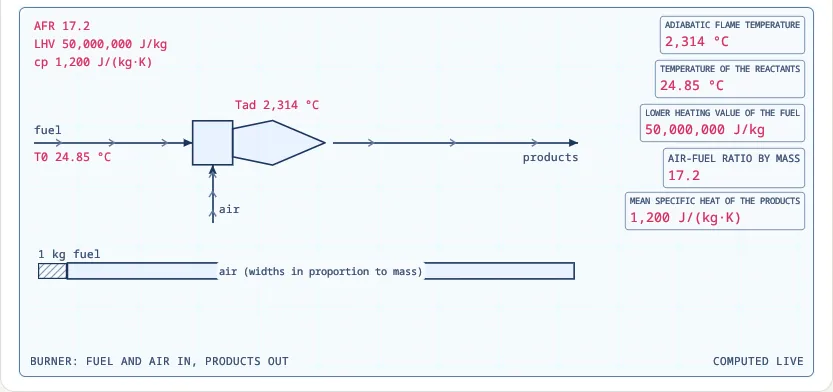 Adiabatic flame temperature with constant product specific heat | 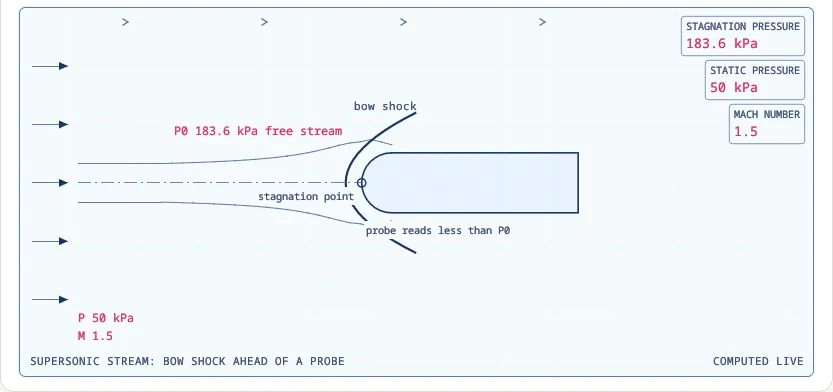 Isentropic stagnation pressure of air from the Mach number |
Charts:
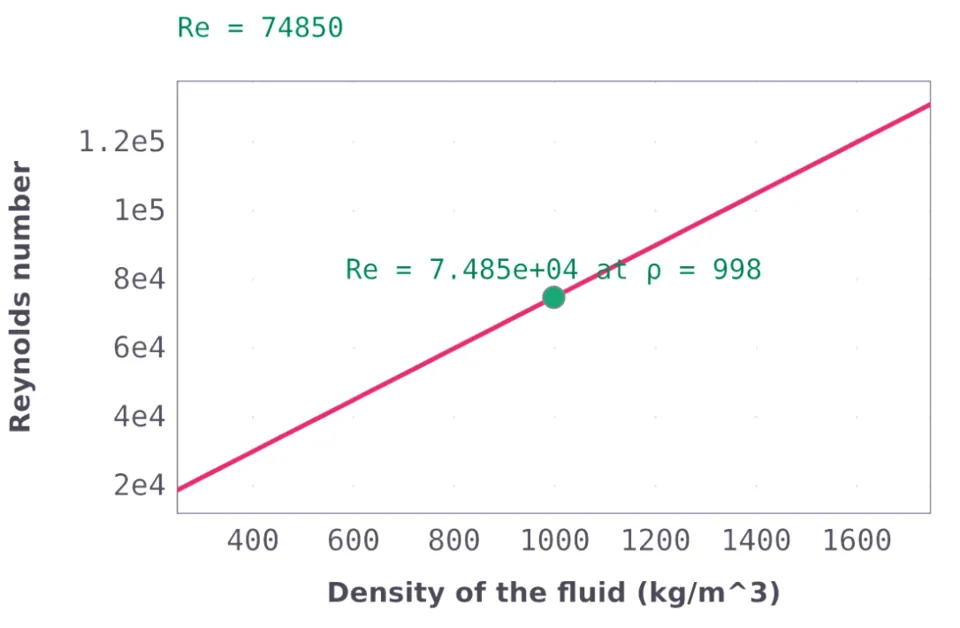 Reynolds number from density, velocity, diameter and viscosity | 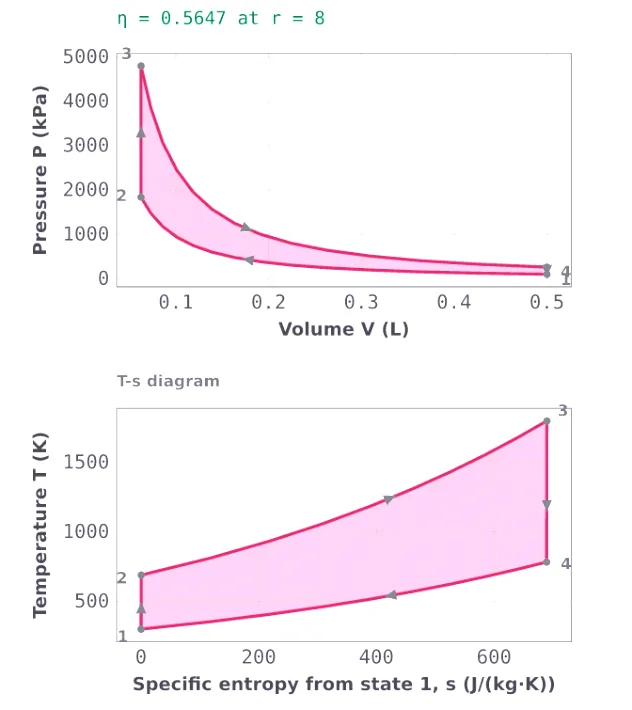 Thermal efficiency of the air-standard Otto cycle | 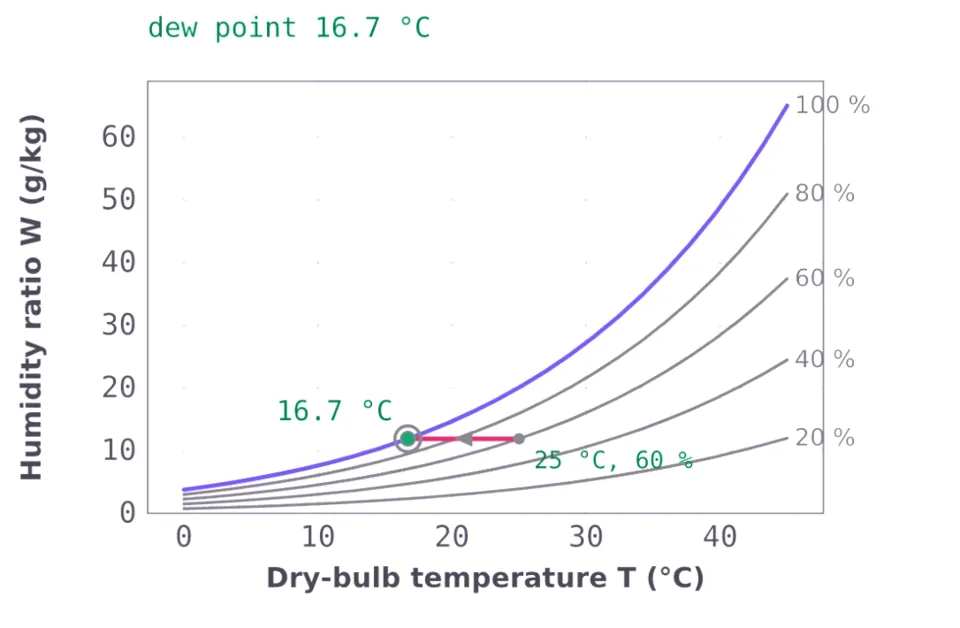 Dew-point temperature from dry-bulb temperature and relative humidity | 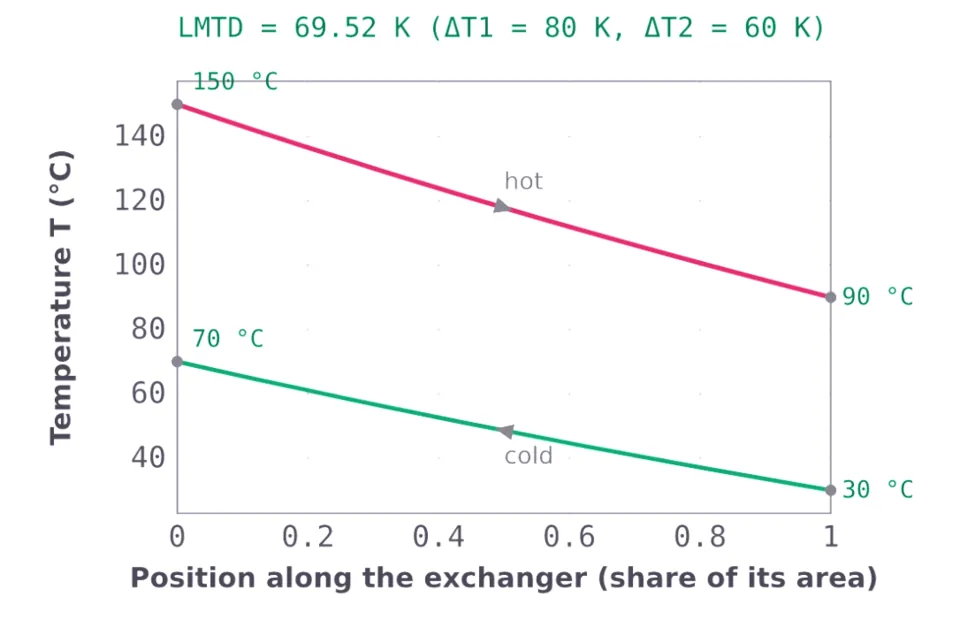 Log-mean temperature difference of a heat exchanger |
Ask in words: 14 examples
Each question below was asked on this release; the comment under it is the line it printed.
import thermofluids_ai999x as thermofluids

a = thermofluids.ask(
    "Pin fin efficiency: h = 50 W/(m^2*K), k = 200 W/(m*K), D = 5 mm, "
    "L = 50 mm"
)
print(a.outcome, a.values)
# SOLVED {'efficiency': 0.8610571715805476, 'mL': 0.7071067811865476}

a = thermofluids.ask(
    "Bernoulli equation with height: P1 = 200 kPa, v1 = 2 m/s, h1 = 0 "
    "m, v2 = 6 m/s, h2 = 5 m, rho = 1000 kg/m^3, g = 9.81 m/s^2"
)
print(a.outcome, a.values)
# SOLVED {'P2': 134950.0}

a = thermofluids.ask("Dew point temperature: T = 25 °C, RH = 60%")
print(a.outcome, a.values)
# SOLVED {'T_dew': 289.85113185453645, 'p_v': 1901.5298820861765}

a = thermofluids.ask(
    "Isobaric work: P = 200 kPa, V1 = 0.010 m^3, V2 = 0.025 m^3"
)
print(a.outcome, a.values)
# SOLVED {'W': 3000.0000000000005, 'dV': 0.015000000000000001}

a = thermofluids.ask(
    "Churchill-Bernstein correlation: Re = 10000, Pr = 0.7"
)
print(a.outcome, a.values)
# SOLVED {'Nu': 53.32778867020997}

a = thermofluids.ask(
    "Colebrook friction factor: Re = 100000, eD = 0.0002"
)
print(a.outcome, a.values)
# SOLVED {'f': 0.01900543522195957}

a = thermofluids.ask(
    "Humidity ratio: T = 30 °C, RH = 50%, P = 101325 Pa"
)
print(a.outcome, a.values)
# SOLVED {'W': 0.01331020383863019, 'p_v': 2123.015121796302}

a = thermofluids.ask(
    "Entropy change of a reservoir: Q = 1000 J, T = 300 K"
)
print(a.outcome, a.values)
# SOLVED {'dS': 3.3333333333333335}

a = thermofluids.ask(
    "Hydraulic press: F1 = 100 N, A1 = 0.01 m^2, A2 = 0.5 m^2"
)
print(a.outcome, a.values)
# SOLVED {'F2': 5000.0, 'P': 10000.0, 'MA': 50.0, 'd_ratio': 0.02}

a = thermofluids.ask("Saturation vapour pressure of water: T = 25 °C")
print(a.outcome, a.values)
# SOLVED {'p_sat': 3169.2164701436277}

a = thermofluids.ask(
    "First law of thermodynamics: Q = 500 J, W = 200 J"
)
print(a.outcome, a.values)
# SOLVED {'dU': 300.0}

a = thermofluids.ask(
    "Gnielinski correlation: Re = 50000, Pr = 5, f = 0.021"
)
print(a.outcome, a.values)
# SOLVED {'Nu': 285.58931252195663}

a = thermofluids.ask(
    "Counterflow LMTD: Th_in = 150 °C, Th_out = 90 °C, Tc_in = 30 °C, "
    "Tc_out = 70 °C"
)
print(a.outcome, a.values)
# SOLVED {'lmtd': 69.52118993564416, 'dT1': 80.0, 'dT2': 60.0}

a = thermofluids.ask(
    "Wet bulb temperature: T = 30 °C, RH = 40%, P = 101325 Pa"
)
print(a.outcome, a.values)
# SOLVED {'T_wb': 293.2143470642154, 'W': 0.010602781187021928}
Command line: 15 examples
Each command below was run with thermofluids of this release; the lines under it are the answer it printed (the full answer goes on with the method, every input in SI units and the conditions it assumes).
$ thermofluids solve thin_airfoil_lift_coefficient "alpha=0.0872664626 rad"
section lift coefficient (CL) = 0.5483113556

$ thermofluids solve blasius_average_skin_friction "ReL=250000 1"
average skin-friction coefficient over the plate (cfm) = 0.00265645869

$ thermofluids solve adiabatic_flame_temperature_simple "T0=298 K" "LHV=50000000 J/kg" "AFR=17.2 1" "cp=1200 J/(kg*K)"
adiabatic flame temperature (Tad) = 2587.377289 K

$ thermofluids solve stagnation_pressure_air "P=50000 Pa" "M=1.5 1"
stagnation pressure (P0) = 183551.5314 Pa

$ thermofluids solve critical_insulation_radius "k=0.05 W/(m*K)" "h=10 W/(m^2*K)"
critical outer radius of the insulation (r) = 0.005 m

$ thermofluids solve flat_plate_laminar_average_nusselt "ReL=100000 1" "Pr=0.7 1"
average Nusselt number over the plate (Nu) = 186.4378529

$ thermofluids solve drag_force "Cd=0.3 1" "rho=1.2 kg/m^3" "v=30 m/s" "A=2.2 m^2"
drag force (F) = 356.4 N

$ thermofluids solve pin_fin_efficiency "h=50 W/(m^2*K)" "k=200 W/(m*K)" "D=5 mm" "L=50 mm"
efficiency = 0.8610571716
mL = 0.7071067812

$ thermofluids solve bernoulli_horizontal "P1=200000 Pa" "rho=1000 kg/m^3" "v1=2 m/s" "v2=6 m/s"
pressure at the outlet (P2) = 184000 Pa

$ thermofluids solve bernoulli_with_height "P1=200 kPa" "v1=2 m/s" "h1=0 m" "v2=6 m/s" "h2=5 m" "rho=1000 kg/m^3" "g=9.81 m/s^2"
P2 = 134950 Pa

$ thermofluids solve absolute_pressure_depth "P0=101325 Pa" "rho=1025 kg/m^3" "g=9.80665 m/s^2" "h=20 m"
absolute pressure at the depth (P) = 302361.325 Pa

$ thermofluids solve compressor_outlet_temperature_air "T1=300 K" "P2=600000 Pa" "P1=100000 Pa" "eta=0.85 1"
final temperature (T2) = 535.9448615 K

$ thermofluids solve effectiveness_phase_change "N=2 1"
heat exchanger effectiveness (eps) = 0.8646647168

$ thermofluids solve grashof_number "g=9.80665 m/s^2" "beta=0.0033 1/K" "Ts=330 K" "Tinf=300 K" "L=0.5 m" "nu=1.6e-05 m^2/s"
Grashof number (Gr) = 474051928.7

$ thermofluids solve froude_number "v=3 m/s" "g=9.80665 m/s^2" "h=0.5 m"
Froude number (Fr) = 1.354802267
Guides
- Desktop app guide: the window, every calculation, scenes and charts: PDF · HTML · Markdown
- Python guide: every calculation with a Python example: PDF · HTML · Markdown
- Command-line guide: every calculation with the command and what it printed: PDF · HTML · Markdown
Every calculation, with its formula, a worked example and its figures: Thermofluids on ai999x.com. Install guides for the app and the command line: https://www.ai999x.com/desktop-cli/.
Version 1.6.7 · License: Apache-2.0 · Author: Ibnul Jaif Farabi · Organization: AI999X · Contact: support@ai999x.com · Support the project
The Future Is Self-Improving.