This model has been pushed to the Hub using the PytorchModelHubMixin integration:
This is a LightGlue variant trained on DISK, with a commecially permissive license, which requires kornia to be installed and is usable with transformers up to v5.4.0 with the following lines of code
from transformers import LightGlueForKeypointMatching

model = LightGlueForKeypointMatching.from_pretrained("ETH-CVG/lightglue_disk", trust_remote_code=True)
LightGlue
The LightGlue model was proposed in LightGlue: Local Feature Matching at Light Speed by Philipp Lindenberger, Paul-Edouard Sarlin and Marc Pollefeys.
This model consists of matching two sets of interest points detected in an image. Paired with the SuperPoint model, it can be used to match two images and estimate the pose between them. This model is useful for tasks such as image matching, homography estimation, etc.
The abstract from the paper is the following : We introduce LightGlue, a deep neural network that learns to match local features across images. We revisit multiple design decisions of SuperGlue, the state of the art in sparse matching, and derive simple but effective improvements. Cumulatively, they make LightGlue more efficient – in terms of both memory and computation, more accurate, and much easier to train. One key property is that LightGlue is adaptive to the difficulty of the problem: the inference is much faster on image pairs that are intuitively easy to match, for example because of a larger visual overlap or limited appearance change. This opens up exciting prospects for deploying deep matchers in latency-sensitive applications like 3D reconstruction. The code and trained models are publicly available at github.com/cvg/LightGlue.
This model was contributed by stevenbucaille. The original code can be found here.
Demo notebook
A demo notebook showcasing inference + visualization with LightGlue can be found TBD.
Model Details
Model Description
LightGlue is a neural network that matches two sets of local features by jointly finding correspondences and rejecting non-matchable points. Building on the success of SuperGlue, this model has the ability to introspect the confidence of its own predictions. It adapts the amount of computation to the difficulty of each image pair to match. Both its depth and width are adaptive :
- the inference can stop at an early layer if all predictions are ready
- points that are deemed not matchable are discarded early from further steps. The resulting model, LightGlue, is finally faster, more accurate, and easier to train than the long-unrivaled SuperGlue.
- Developed by: ETH Zurich - Computer Vision and Geometry Lab
- Model type: Image Matching
- License: Apache 2.0
Model Sources
- Repository: https://github.com/cvg/LightGlue
- Paper: http://arxiv.org/abs/2306.13643
- Demo: https://colab.research.google.com/github/cvg/LightGlue/blob/main/demo.ipynb
Uses
Direct Use
LightGlue is designed for feature matching and pose estimation tasks in computer vision. It can be applied to a variety of multiple-view geometry problems and can handle challenging real-world indoor and outdoor environments. However, it may not perform well on tasks that require different types of visual understanding, such as object detection or image classification.
How to Get Started with the Model
Here is a quick example of using the model. Since this model is an image matching model, it requires pairs of images to be matched. The raw outputs contain the list of keypoints detected by the keypoint detector as well as the list of matches with their corresponding matching scores.
from transformers import AutoImageProcessor, AutoModel
import torch
from PIL import Image
import requests

url_image1 = "https://raw.githubusercontent.com/magicleap/SuperGluePretrainedNetwork/refs/heads/master/assets/phototourism_sample_images/united_states_capitol_98169888_3347710852.jpg"
image1 = Image.open(requests.get(url_image1, stream=True).raw)
url_image2 = "https://raw.githubusercontent.com/magicleap/SuperGluePretrainedNetwork/refs/heads/master/assets/phototourism_sample_images/united_states_capitol_26757027_6717084061.jpg"
image2 = Image.open(requests.get(url_image2, stream=True).raw)

images = [image1, image2]

processor = AutoImageProcessor.from_pretrained("ETH-CVG/lightglue_disk", trust_remote_code=True)
model = AutoModel.from_pretrained("ETH-CVG/lightglue_disk")

inputs = processor(images, return_tensors="pt")
with torch.no_grad():
    outputs = model(**inputs)
You can use the post_process_keypoint_matching method from the LightGlueImageProcessor to get the keypoints and matches in a readable format:
image_sizes = [[(image.height, image.width) for image in images]]
outputs = processor.post_process_keypoint_matching(outputs, image_sizes, threshold=0.2)
for i, output in enumerate(outputs):
    print("For the image pair", i)
    for keypoint0, keypoint1, matching_score in zip(
            output["keypoints0"], output["keypoints1"], output["matching_scores"]
    ):
        print(
            f"Keypoint at coordinate {keypoint0.numpy()} in the first image matches with keypoint at coordinate {keypoint1.numpy()} in the second image with a score of {matching_score}."
        )
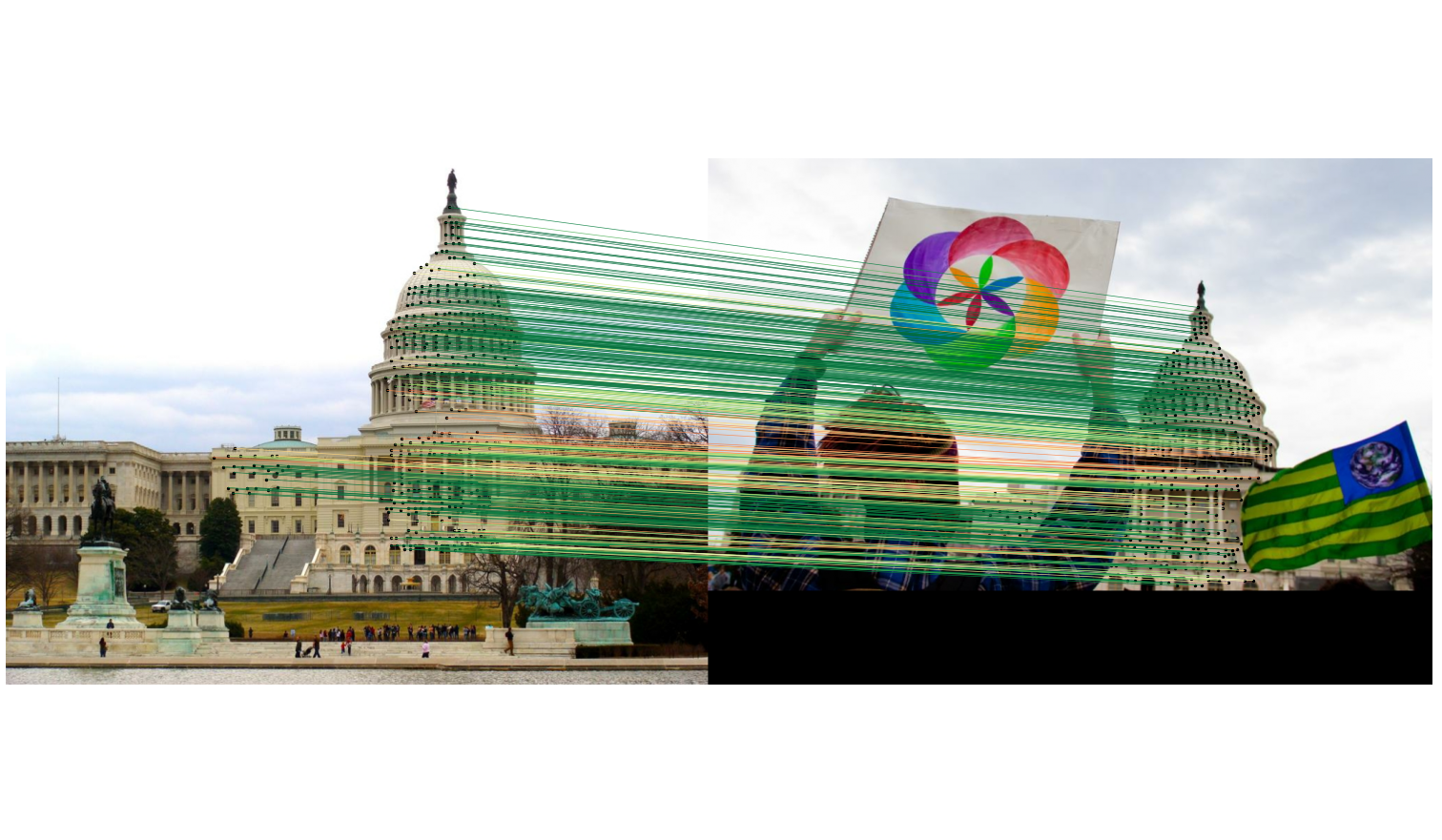
You can visualize the matches between the images by providing the original images as well as the outputs to this method:
processor.plot_keypoint_matching(images, outputs)
Training Details
LightGlue is trained on large annotated datasets for pose estimation, enabling it to learn priors for pose estimation and reason about the 3D scene. The training data consists of image pairs with ground truth correspondences and unmatched keypoints derived from ground truth poses and depth maps.
LightGlue follows the supervised training setup of SuperGlue. It is first pre-trained with synthetic homographies sampled from 1M images. Such augmentations provide full and noise-free supervision but require careful tuning. LightGlue is then fine-tuned with the MegaDepth dataset, which includes 1M crowd-sourced images depicting 196 tourism landmarks, with camera calibration and poses recovered by SfM and dense depth by multi-view stereo.
Training Hyperparameters
- Training regime: fp32
Speeds, Sizes, Times
LightGlue is designed to be efficient and runs in real-time on a modern GPU. A forward pass takes approximately 44 milliseconds (22 FPS) for an image pair. The model has 13.7 million parameters, making it relatively compact compared to some other deep learning models. The inference speed of LightGlue is suitable for real-time applications and can be readily integrated into modern Simultaneous Localization and Mapping (SLAM) or Structure-from-Motion (SfM) systems.
Citation
BibTeX:
@inproceedings{lindenberger2023lightglue,
  author    = {Philipp Lindenberger and
               Paul-Edouard Sarlin and
               Marc Pollefeys},
  title     = {{LightGlue: Local Feature Matching at Light Speed}},
  booktitle = {ICCV},
  year      = {2023}
}