
Credit for the model card's description goes to ddh0, mergekit, and, 01-ai
Inspired by abacusai's bigyi-15b
BigYi-15.75B-200K
This is BigYi-15.75B-200K, a layer-interleaved version of 01-ai/Yi-9B-200K. This model is intended to be used as a basis for further fine-tuning, or as a drop-in upgrade from the original 9 billion parameter model.
This is a merge of pre-trained language models created using mergekit.
BigYi-15.75B-200K is a base/completion model. So, there is no chat template.
Merge Details
Merge Method
This model was merged using the passthrough merge method.
Models Merged
The following models were included in the merge:
- /Users/jsarnecki/opt/workspace/01-ai/Yi-9B-200K
Configuration
The following YAML configuration was used to produce this model:
dtype: bfloat16
merge_method: passthrough
# Layer-Interleaving of Yi-9B-200k
# where n = 48 (The number of layers the model originally had)
#       m = 12 (The number of layers to interleave per row)
#       M = 36 = 3m (The number of layers interleaved into the model)
#       s = 48 + 36 = n + M (The number of layers the model will have after the layer interleaving)
#       P = 15.75B parameters = (s/n)*9 (The number of parameters the model will have after the layer interleaving)
slices:
- sources:
  - layer_range: [0, 12]
    model: /Users/jsarnecki/opt/workspace/01-ai/Yi-9B-200K

# Interleaved Layer
- sources:
  - layer_range: [6, 18]
    model: /Users/jsarnecki/opt/workspace/01-ai/Yi-9B-200K

- sources:
  - layer_range: [12, 24]
    model: /Users/jsarnecki/opt/workspace/01-ai/Yi-9B-200K

# Interleaved Layer
- sources:
  - layer_range: [18, 30]
    model: /Users/jsarnecki/opt/workspace/01-ai/Yi-9B-200K

- sources:
  - layer_range: [24, 36]
    model: /Users/jsarnecki/opt/workspace/01-ai/Yi-9B-200K

# Interleaved Layer
- sources:
  - layer_range: [30, 42]
    model: /Users/jsarnecki/opt/workspace/01-ai/Yi-9B-200K

- sources:
  - layer_range: [36, 48]
    model: /Users/jsarnecki/opt/workspace/01-ai/Yi-9B-200K
What is Yi?
Introduction
-
🤖 The Yi series models are the next generation of open-source large language models trained from scratch by 01.AI.
-
🙌 Targeted as a bilingual language model and trained on 3T multilingual corpus, the Yi series models become one of the strongest LLM worldwide, showing promise in language understanding, commonsense reasoning, reading comprehension, and more. For example,
-
Yi-34B-Chat model landed in second place (following GPT-4 Turbo), outperforming other LLMs (such as GPT-4, Mixtral, Claude) on the AlpacaEval Leaderboard (based on data available up to January 2024).
-
Yi-34B model ranked first among all existing open-source models (such as Falcon-180B, Llama-70B, Claude) in both English and Chinese on various benchmarks, including Hugging Face Open LLM Leaderboard (pre-trained) and C-Eval (based on data available up to November 2023).
-
🙏 (Credits to Llama) Thanks to the Transformer and Llama open-source communities, as they reduce the efforts required to build from scratch and enable the utilization of the same tools within the AI ecosystem.
-
💡 TL;DR
The Yi series models adopt the same model architecture as Llama but are NOT derivatives of Llama.
-
Both Yi and Llama are based on the Transformer structure, which has been the standard architecture for large language models since 2018.
-
Grounded in the Transformer architecture, Llama has become a new cornerstone for the majority of state-of-the-art open-source models due to its excellent stability, reliable convergence, and robust compatibility. This positions Llama as the recognized foundational framework for models including Yi.
-
Thanks to the Transformer and Llama architectures, other models can leverage their power, reducing the effort required to build from scratch and enabling the utilization of the same tools within their ecosystems.
-
However, the Yi series models are NOT derivatives of Llama, as they do not use Llama's weights.
-
As Llama's structure is employed by the majority of open-source models, the key factors of determining model performance are training datasets, training pipelines, and training infrastructure.
-
Developing in a unique and proprietary way, Yi has independently created its own high-quality training datasets, efficient training pipelines, and robust training infrastructure entirely from the ground up. This effort has led to excellent performance with Yi series models ranking just behind GPT4 and surpassing Llama on the Alpaca Leaderboard in Dec 2023.
-
News
Yi-34B-ChatYi-34B-Chat-4bitsYi-34B-Chat-8bitsYi-6B-ChatYi-6B-Chat-4bitsYi-6B-Chat-8bits
You can try some of them interactively at:
Models
Yi models come in multiple sizes and cater to different use cases. You can also fine-tune Yi models to meet your specific requirements.
If you want to deploy Yi models, make sure you meet the software and hardware requirements.
Chat models
| Model | Download |
|---|---|
| Yi-34B-Chat | • 🤗 Hugging Face • 🤖 ModelScope |
| Yi-34B-Chat-4bits | • 🤗 Hugging Face • 🤖 ModelScope |
| Yi-34B-Chat-8bits | • 🤗 Hugging Face • 🤖 ModelScope |
| Yi-6B-Chat | • 🤗 Hugging Face • 🤖 ModelScope |
| Yi-6B-Chat-4bits | • 🤗 Hugging Face • 🤖 ModelScope |
| Yi-6B-Chat-8bits | • 🤗 Hugging Face • 🤖 ModelScope |
- 4-bit series models are quantized by AWQ. - 8-bit series models are quantized by GPTQ - All quantized models have a low barrier to use since they can be deployed on consumer-grade GPUs (e.g., 3090, 4090).
Base models
| Model | Download |
|---|---|
| Yi-34B | • 🤗 Hugging Face • 🤖 ModelScope |
| Yi-34B-200K | • 🤗 Hugging Face • 🤖 ModelScope |
| Yi-9B | • 🤗 Hugging Face • 🤖 ModelScope |
| Yi-9B-200K | • 🤗 Hugging Face • 🤖 ModelScope |
| Yi-6B | • 🤗 Hugging Face • 🤖 ModelScope |
| Yi-6B-200K | • 🤗 Hugging Face • 🤖 ModelScope |
- 200k is roughly equivalent to 400,000 Chinese characters. - If you want to use the previous version of the Yi-34B-200K (released on Nov 5, 2023), run git checkout 069cd341d60f4ce4b07ec394e82b79e94f656cf to download the weight.
Model info
- For chat and base models
-
For chat models
However, this higher diversity might amplify certain existing issues, including: Hallucination: This refers to the model generating factually incorrect or nonsensical information. With the model's responses being more varied, there's a higher chance of hallucination that are not based on accurate data or logical reasoning. Non-determinism in re-generation: When attempting to regenerate or sample responses, inconsistencies in the outcomes may occur. The increased diversity can lead to varying results even under similar input conditions. Cumulative Error: This occurs when errors in the model's responses compound over time. As the model generates more diverse responses, the likelihood of small inaccuracies building up into larger errors increases, especially in complex tasks like extended reasoning, mathematical problem-solving, etc. To achieve more coherent and consistent responses, it is advisable to adjust generation configuration parameters such as temperature, top_p, or top_k. These adjustments can help in the balance between creativity and coherence in the model's outputs.
How to use Yi?
Quick start
Getting up and running with Yi models is simple with multiple choices available.
Choose your path
Select one of the following paths to begin your journey with Yi!
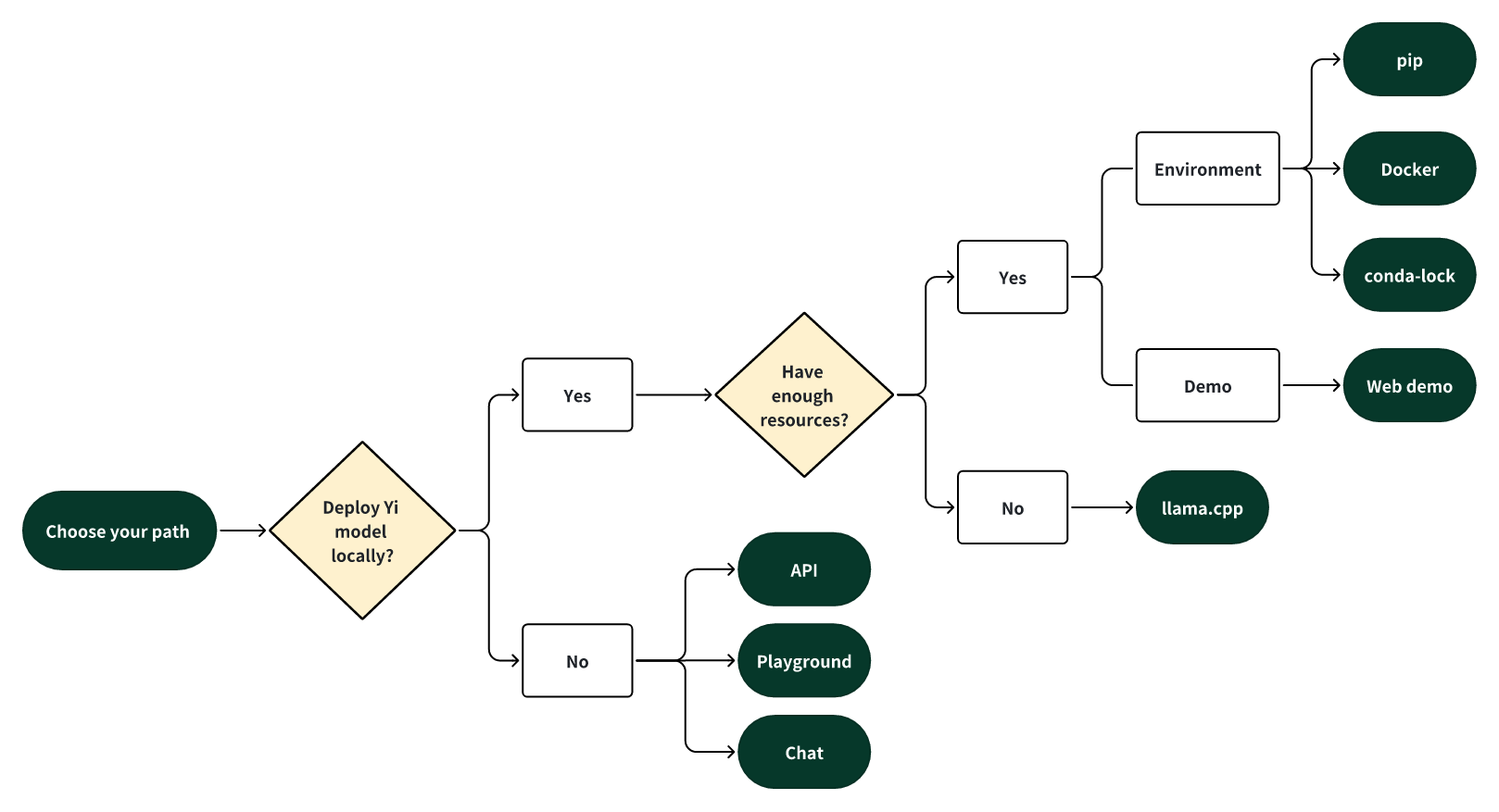
🎯 Deploy Yi locally
If you prefer to deploy Yi models locally,
-
🙋♀️ and you have sufficient resources (for example, NVIDIA A800 80GB), you can choose one of the following methods:
-
🙋♀️ and you have limited resources (for example, a MacBook Pro), you can use llama.cpp.
🎯 Not to deploy Yi locally
If you prefer not to deploy Yi models locally, you can explore Yi's capabilities using any of the following options.
🙋♀️ Run Yi with APIs
If you want to explore more features of Yi, you can adopt one of these methods:
-
Yi APIs (Yi official)
- Early access has been granted to some applicants. Stay tuned for the next round of access!
-
Yi APIs (Replicate)
🙋♀️ Run Yi in playground
If you want to chat with Yi with more customizable options (e.g., system prompt, temperature, repetition penalty, etc.), you can try one of the following options:
-
Yi-34B-Chat-Playground (Yi official)
-
Yi-34B-Chat-Playground (Replicate)
🙋♀️ Chat with Yi
If you want to chat with Yi, you can use one of these online services, which offer a similar user experience:
-
Yi-34B-Chat (Yi official on Hugging Face)
- No registration is required.
-
Yi-34B-Chat (Yi official beta)
Quick start - pip
This tutorial guides you through every step of running Yi-34B-Chat locally on an A800 (80G) and then performing inference.
Step 0: Prerequisites
-
Make sure Python 3.10 or a later version is installed.
-
If you want to run other Yi models, see software and hardware requirements.
Step 1: Prepare your environment
To set up the environment and install the required packages, execute the following command.
git clone https://github.com/01-ai/Yi.git
cd yi
pip install -r requirements.txt
Step 2: Download the Yi model
You can download the weights and tokenizer of Yi models from the following sources:
Step 3: Perform inference
You can perform inference with Yi chat or base models as below.
Perform inference with Yi chat model
-
Create a file named
quick_start.pyand copy the following content to it.from transformers import AutoModelForCausalLM, AutoTokenizer model_path = '<your-model-path>' tokenizer = AutoTokenizer.from_pretrained(model_path, use_fast=False) # Since transformers 4.35.0, the GPT-Q/AWQ model can be loaded using AutoModelForCausalLM. model = AutoModelForCausalLM.from_pretrained( model_path, device_map="auto", torch_dtype='auto' ).eval() # Prompt content: "hi" messages = [ {"role": "user", "content": "hi"} ] input_ids = tokenizer.apply_chat_template(conversation=messages, tokenize=True, add_generation_prompt=True, return_tensors='pt') output_ids = model.generate(input_ids.to('cuda')) response = tokenizer.decode(output_ids[0][input_ids.shape[1]:], skip_special_tokens=True) # Model response: "Hello! How can I assist you today?" print(response) -
Run
quick_start.py.python quick_start.pyThen you can see an output similar to the one below. 🥳
Hello! How can I assist you today?
Perform inference with Yi base model
-
Yi-34B
The steps are similar to pip - Perform inference with Yi chat model.
You can use the existing file
text_generation.py.python demo/text_generation.py --model <your-model-path>Then you can see an output similar to the one below. 🥳
Prompt: Let me tell you an interesting story about cat Tom and mouse Jerry,
Generation: Let me tell you an interesting story about cat Tom and mouse Jerry, which happened in my childhood. My father had a big house with two cats living inside it to kill mice. One day when I was playing at home alone, I found one of the tomcats lying on his back near our kitchen door, looking very much like he wanted something from us but couldn’t get up because there were too many people around him! He kept trying for several minutes before finally giving up...
-
Yi-9B
Input
from transformers import AutoModelForCausalLM, AutoTokenizer

MODEL_DIR = "01-ai/Yi-9B"
model = AutoModelForCausalLM.from_pretrained(MODEL_DIR, torch_dtype="auto")
tokenizer = AutoTokenizer.from_pretrained(MODEL_DIR, use_fast=False)

input_text = "# write the quick sort algorithm"
inputs = tokenizer(input_text, return_tensors="pt").to(model.device)
outputs = model.generate(**inputs, max_length=256)
print(tokenizer.decode(outputs[0], skip_special_tokens=True))
Output
# write the quick sort algorithm
def quick_sort(arr):
    if len(arr) <= 1:
        return arr
    pivot = arr[len(arr) // 2]
    left = [x for x in arr if x < pivot]
    middle = [x for x in arr if x == pivot]
    right = [x for x in arr if x > pivot]
    return quick_sort(left) + middle + quick_sort(right)

# test the quick sort algorithm
print(quick_sort([3, 6, 8, 10, 1, 2, 1]))
Quick start - Docker
Quick start - conda-lock
-
Install micromamba by following the instructions available here.
-
Execute micromamba install -y -n yi -f conda-lock.yml to create a conda environment named yi and install the necessary dependencies.
Quick start - llama.cpp
- Step 0: Prerequisites
- Step 1: Download llama.cpp
- Step 2: Download Yi model
- Step 3: Perform inference
Step 0: Prerequisites
-
This tutorial assumes you use a MacBook Pro with 16GB of memory and an Apple M2 Pro chip.
-
Make sure
git-lfsis installed on your machine.
Step 1: Download llama.cpp
To clone the llama.cpp repository, run the following command.
git clone git@github.com:ggerganov/llama.cpp.git
Step 2: Download Yi model
2.1 To clone XeIaso/yi-chat-6B-GGUF with just pointers, run the following command.
GIT_LFS_SKIP_SMUDGE=1 git clone https://huggingface.co/XeIaso/yi-chat-6B-GGUF
2.2 To download a quantized Yi model (yi-chat-6b.Q2_K.gguf), run the following command.
git-lfs pull --include yi-chat-6b.Q2_K.gguf
Step 3: Perform inference
To perform inference with the Yi model, you can use one of the following methods.
Method 1: Perform inference in terminal
To compile llama.cpp using 4 threads and then conduct inference, navigate to the llama.cpp directory, and run the following command.
Tips
Replace
/Users/yu/yi-chat-6B-GGUF/yi-chat-6b.Q2_K.ggufwith the actual path of your model.By default, the model operates in completion mode.
For additional output customization options (for example, system prompt, temperature, repetition penalty, etc.), run
./main -hto check detailed descriptions and usage.
make -j4 && ./main -m /Users/yu/yi-chat-6B-GGUF/yi-chat-6b.Q2_K.gguf -p "How do you feed your pet fox? Please answer this question in 6 simple steps:\nStep 1:" -n 384 -e

...

How do you feed your pet fox? Please answer this question in 6 simple steps:

Step 1: Select the appropriate food for your pet fox. You should choose high-quality, balanced prey items that are suitable for their unique dietary needs. These could include live or frozen mice, rats, pigeons, or other small mammals, as well as fresh fruits and vegetables.

Step 2: Feed your pet fox once or twice a day, depending on the species and its individual preferences. Always ensure that they have access to fresh water throughout the day.

Step 3: Provide an appropriate environment for your pet fox. Ensure it has a comfortable place to rest, plenty of space to move around, and opportunities to play and exercise.

Step 4: Socialize your pet with other animals if possible. Interactions with other creatures can help them develop social skills and prevent boredom or stress.

Step 5: Regularly check for signs of illness or discomfort in your fox. Be prepared to provide veterinary care as needed, especially for common issues such as parasites, dental health problems, or infections.

Step 6: Educate yourself about the needs of your pet fox and be aware of any potential risks or concerns that could affect their well-being. Regularly consult with a veterinarian to ensure you are providing the best care.

...
Now you have successfully asked a question to the Yi model and got an answer! 🥳
Method 2: Perform inference in web
-
To initialize a lightweight and swift chatbot, run the following command.
cd llama.cpp
./server --ctx-size 2048 --host 0.0.0.0 --n-gpu-layers 64 --model /Users/yu/yi-chat-6B-GGUF/yi-chat-6b.Q2_K.gguf
Then you can get an output like this:
... llama_new_context_with_model: n_ctx = 2048 llama_new_context_with_model: freq_base = 5000000.0 llama_new_context_with_model: freq_scale = 1 ggml_metal_init: allocating ggml_metal_init: found device: Apple M2 Pro ggml_metal_init: picking default device: Apple M2 Pro ggml_metal_init: ggml.metallib not found, loading from source ggml_metal_init: GGML_METAL_PATH_RESOURCES = nil ggml_metal_init: loading '/Users/yu/llama.cpp/ggml-metal.metal' ggml_metal_init: GPU name: Apple M2 Pro ggml_metal_init: GPU family: MTLGPUFamilyApple8 (1008) ggml_metal_init: hasUnifiedMemory = true ggml_metal_init: recommendedMaxWorkingSetSize = 11453.25 MB ggml_metal_init: maxTransferRate = built-in GPU ggml_backend_metal_buffer_type_alloc_buffer: allocated buffer, size = 128.00 MiB, ( 2629.44 / 10922.67) llama_new_context_with_model: KV self size = 128.00 MiB, K (f16): 64.00 MiB, V (f16): 64.00 MiB ggml_backend_metal_buffer_type_alloc_buffer: allocated buffer, size = 0.02 MiB, ( 2629.45 / 10922.67) llama_build_graph: non-view tensors processed: 676/676 llama_new_context_with_model: compute buffer total size = 159.19 MiB ggml_backend_metal_buffer_type_alloc_buffer: allocated buffer, size = 156.02 MiB, ( 2785.45 / 10922.67) Available slots: -> Slot 0 - max context: 2048 llama server listening at http://0.0.0.0:8080 -
To access the chatbot interface, open your web browser and enter
http://0.0.0.0:8080into the address bar.
-
Enter a question, such as "How do you feed your pet fox? Please answer this question in 6 simple steps" into the prompt window, and you will receive a corresponding answer.

Web demo
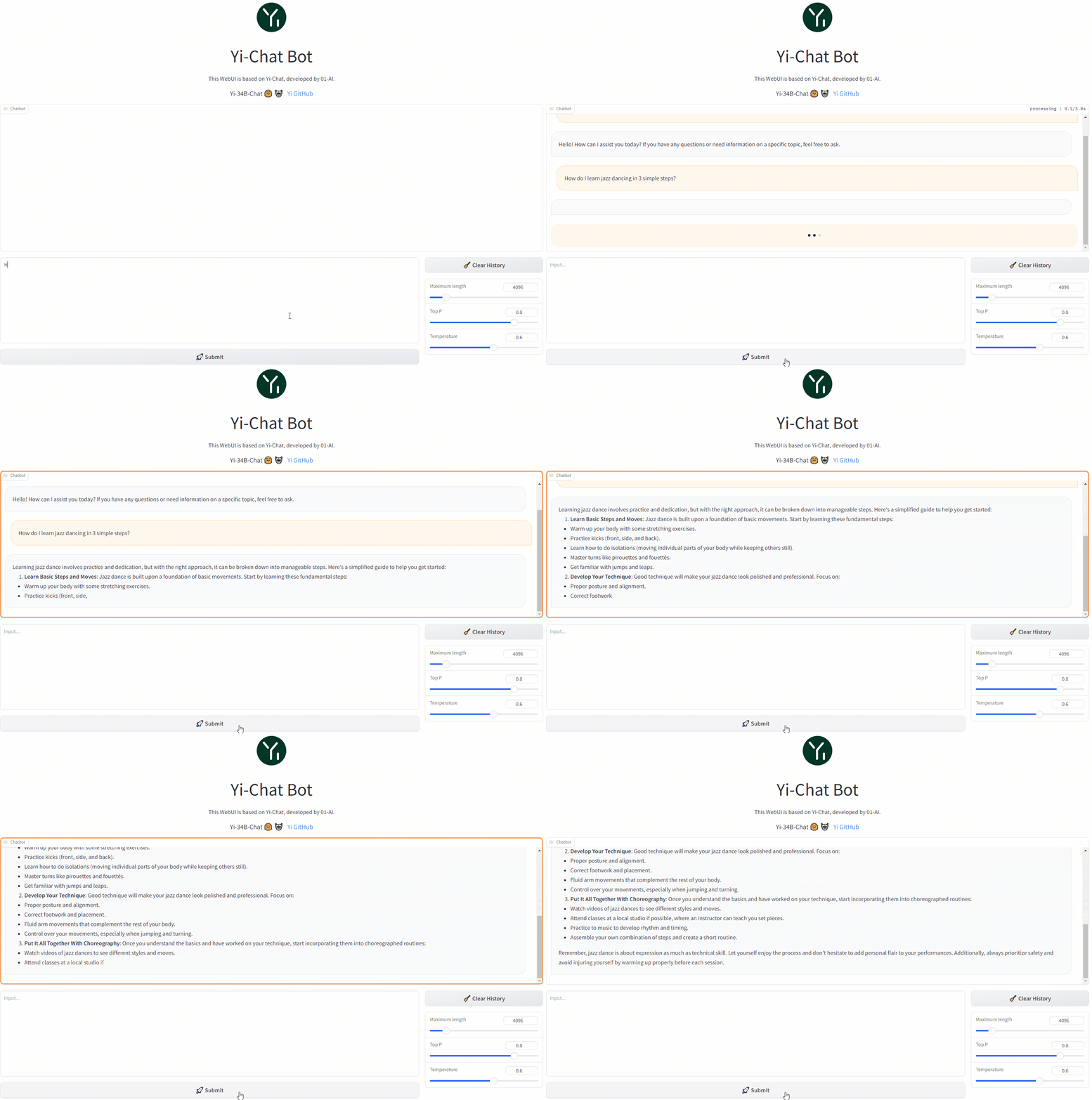
You can build a web UI demo for Yi chat models (note that Yi base models are not supported in this senario).
Step 1: Prepare your environment.
Step 2: Download the Yi model.
Step 3. To start a web service locally, run the following command.
python demo/web_demo.py -c <your-model-path>
You can access the web UI by entering the address provided in the console into your browser.
Fine-tuning
bash finetune/scripts/run_sft_Yi_6b.sh
Once finished, you can compare the finetuned model and the base model with the following command:
bash finetune/scripts/run_eval.sh
Finetune code for Yi 6B and 34B
Preparation
From Image
By default, we use a small dataset from BAAI/COIG to finetune the base model.
You can also prepare your customized dataset in the following jsonl format:
{ "prompt": "Human: Who are you? Assistant:", "chosen": "I'm Yi." }
And then mount them in the container to replace the default ones:
docker run -it \
    -v /path/to/save/finetuned/model/:/finetuned-model \
    -v /path/to/train.jsonl:/yi/finetune/data/train.json \
    -v /path/to/eval.jsonl:/yi/finetune/data/eval.json \
    ghcr.io/01-ai/yi:latest \
    bash finetune/scripts/run_sft_Yi_6b.sh
From Local Server
Make sure you have conda. If not, use
mkdir -p ~/miniconda3
wget https://repo.anaconda.com/miniconda/Miniconda3-latest-Linux-x86_64.sh -O ~/miniconda3/miniconda.sh
bash ~/miniconda3/miniconda.sh -b -u -p ~/miniconda3
rm -rf ~/miniconda3/miniconda.sh
~/miniconda3/bin/conda init bash
source ~/.bashrc
Then, create a conda env:
conda create -n dev_env python=3.10 -y
conda activate dev_env
pip install torch==2.0.1 deepspeed==0.10 tensorboard transformers datasets sentencepiece accelerate ray==2.7
Hardware Setup
For the Yi-6B model, a node with 4 GPUs, each with GPU memory larger than 60GB, is recommended.
For the Yi-34B model, because the usage of the zero-offload technique consumes a lot of CPU memory, please be careful to limit the number of GPUs in the 34B finetune training. Please use CUDA_VISIBLE_DEVICES to limit the number of GPUs (as shown in scripts/run_sft_Yi_34b.sh).
A typical hardware setup for finetuning the 34B model is a node with 8 GPUs (limited to 4 in running by CUDA_VISIBLE_DEVICES=0,1,2,3), each with GPU memory larger than 80GB, and total CPU memory larger than 900GB.
Quick Start
Download a LLM-base model to MODEL_PATH (6B and 34B). A typical folder of models is like:
|-- $MODEL_PATH
|   |-- config.json
|   |-- pytorch_model-00001-of-00002.bin
|   |-- pytorch_model-00002-of-00002.bin
|   |-- pytorch_model.bin.index.json
|   |-- tokenizer_config.json
|   |-- tokenizer.model
|   |-- ...
Download a dataset from huggingface to local storage DATA_PATH, e.g. Dahoas/rm-static.
|-- $DATA_PATH
|   |-- data
|   |   |-- train-00000-of-00001-2a1df75c6bce91ab.parquet
|   |   |-- test-00000-of-00001-8c7c51afc6d45980.parquet
|   |-- dataset_infos.json
|   |-- README.md
finetune/yi_example_dataset has example datasets, which are modified from BAAI/COIG
|-- $DATA_PATH
    |--data
        |-- train.jsonl
        |-- eval.jsonl
cd into the scripts folder, copy and paste the script, and run. For example:
cd finetune/scripts

bash run_sft_Yi_6b.sh
For the Yi-6B base model, setting training_debug_steps=20 and num_train_epochs=4 can output a chat model, which takes about 20 minutes.
For the Yi-34B base model, it takes a relatively long time for initialization. Please be patient.
Evaluation
cd finetune/scripts

bash run_eval.sh
Then you'll see the answer from both the base model and the finetuned model.
Quantization
GPT-Q
python quantization/gptq/quant_autogptq.py \
  --model /base_model                      \
  --output_dir /quantized_model            \
  --trust_remote_code
Once finished, you can then evaluate the resulting model as follows:
python quantization/gptq/eval_quantized_model.py \
  --model /quantized_model                       \
  --trust_remote_code
GPT-Q quantization
GPT-Q is a PTQ (Post-Training Quantization) method. It saves memory and provides potential speedups while retaining the accuracy of the model.
Yi models can be GPT-Q quantized without a lot of efforts. We provide a step-by-step tutorial below.
To run GPT-Q, we will use AutoGPTQ and exllama. And the huggingface transformers has integrated optimum and auto-gptq to perform GPTQ quantization on language models.
Do Quantization
The quant_autogptq.py script is provided for you to perform GPT-Q quantization:
python quant_autogptq.py --model /base_model \
    --output_dir /quantized_model --bits 4 --group_size 128 --trust_remote_code
Run Quantized Model
You can run a quantized model using the eval_quantized_model.py:
python eval_quantized_model.py --model /quantized_model --trust_remote_code
AWQ
python quantization/awq/quant_autoawq.py \
  --model /base_model                      \
  --output_dir /quantized_model            \
  --trust_remote_code
Once finished, you can then evaluate the resulting model as follows:
python quantization/awq/eval_quantized_model.py \
  --model /quantized_model                       \
  --trust_remote_code
AWQ quantization
AWQ is a PTQ (Post-Training Quantization) method. It's an efficient and accurate low-bit weight quantization (INT3/4) for LLMs.
Yi models can be AWQ quantized without a lot of efforts. We provide a step-by-step tutorial below.
To run AWQ, we will use AutoAWQ.
Do Quantization
The quant_autoawq.py script is provided for you to perform AWQ quantization:
python quant_autoawq.py --model /base_model \
    --output_dir /quantized_model --bits 4 --group_size 128 --trust_remote_code
Run Quantized Model
You can run a quantized model using the eval_quantized_model.py:
python eval_quantized_model.py --model /quantized_model --trust_remote_code
Deployment
If you want to deploy Yi models, make sure you meet the software and hardware requirements.
Software requirements
Before using Yi quantized models, make sure you've installed the correct software listed below.
| Model | Software |
|---|---|
| Yi 4-bit quantized models | AWQ and CUDA |
| Yi 8-bit quantized models | GPTQ and CUDA |
Hardware requirements
Before deploying Yi in your environment, make sure your hardware meets the following requirements.
Chat models
| Model | Minimum VRAM | Recommended GPU Example |
|---|---|---|
| Yi-6B-Chat | 15 GB | 1 x RTX 3090 (24 GB) 1 x RTX 4090 (24 GB) 1 x A10 (24 GB) 1 x A30 (24 GB) |
| Yi-6B-Chat-4bits | 4 GB | 1 x RTX 3060 (12 GB) 1 x RTX 4060 (8 GB) |
| Yi-6B-Chat-8bits | 8 GB | 1 x RTX 3070 (8 GB) 1 x RTX 4060 (8 GB) |
| Yi-34B-Chat | 72 GB | 4 x RTX 4090 (24 GB) 1 x A800 (80GB) |
| Yi-34B-Chat-4bits | 20 GB | 1 x RTX 3090 (24 GB) 1 x RTX 4090 (24 GB) 1 x A10 (24 GB) 1 x A30 (24 GB) 1 x A100 (40 GB) |
| Yi-34B-Chat-8bits | 38 GB | 2 x RTX 3090 (24 GB) 2 x RTX 4090 (24 GB) 1 x A800 (40 GB) |
Below are detailed minimum VRAM requirements under different batch use cases.
| Model | batch=1 | batch=4 | batch=16 | batch=32 |
|---|---|---|---|---|
| Yi-6B-Chat | 12 GB | 13 GB | 15 GB | 18 GB |
| Yi-6B-Chat-4bits | 4 GB | 5 GB | 7 GB | 10 GB |
| Yi-6B-Chat-8bits | 7 GB | 8 GB | 10 GB | 14 GB |
| Yi-34B-Chat | 65 GB | 68 GB | 76 GB | > 80 GB |
| Yi-34B-Chat-4bits | 19 GB | 20 GB | 30 GB | 40 GB |
| Yi-34B-Chat-8bits | 35 GB | 37 GB | 46 GB | 58 GB |
Base models
| Model | Minimum VRAM | Recommended GPU Example |
|---|---|---|
| Yi-6B | 15 GB | 1 x RTX 3090 (24 GB) 1 x RTX 4090 (24 GB) 1 x A10 (24 GB) 1 x A30 (24 GB) |
| Yi-6B-200K | 50 GB | 1 x A800 (80 GB) |
| Yi-9B | 20 GB | 1 x RTX 4090 (24 GB) |
| Yi-34B | 72 GB | 4 x RTX 4090 (24 GB) 1 x A800 (80 GB) |
| Yi-34B-200K | 200 GB | 4 x A800 (80 GB) |
Learning hub
Welcome to the Yi learning hub!
Whether you're a seasoned developer or a newcomer, you can find a wealth of helpful educational resources to enhance your understanding and skills with Yi models, including insightful blog posts, comprehensive video tutorials, hands-on guides, and more.
The content you find here has been generously contributed by knowledgeable Yi experts and passionate enthusiasts. We extend our heartfelt gratitude for your invaluable contributions!
At the same time, we also warmly invite you to join our collaborative effort by contributing to Yi. If you have already made contributions to Yi, please don't hesitate to showcase your remarkable work in the table below.
With all these resources at your fingertips, you're ready to start your exciting journey with Yi. Happy learning! 🥳
Tutorials
English tutorials
| Type | Deliverable | Date | Author |
|---|---|---|---|
| Video | Run dolphin-2.2-yi-34b on IoT Devices | 2023-11-30 | Second State |
| Blog | Running Yi-34B-Chat locally using LlamaEdge | 2023-11-30 | Second State |
| Video | Install Yi 34B Locally - Chinese English Bilingual LLM | 2023-11-05 | Fahd Mirza |
| Video | Dolphin Yi 34b - Brand New Foundational Model TESTED | 2023-11-27 | Matthew Berman |
Chinese tutorials
| Type | Deliverable | Date | Author |
|---|---|---|---|
| Blog | 实测零一万物Yi-VL多模态语言模型:能准确“识图吃瓜” | 2024-02-02 | 苏洋 |
| Blog | 本地运行零一万物 34B 大模型,使用 Llama.cpp & 21G 显存 | 2023-11-26 | 苏洋 |
| Blog | 零一万物模型折腾笔记:官方 Yi-34B 模型基础使用 | 2023-12-10 | 苏洋 |
| Blog | CPU 混合推理,非常见大模型量化方案:“二三五六” 位量化方案 | 2023-12-12 | 苏洋 |
| Blog | 单卡 3 小时训练 Yi-6B 大模型 Agent:基于 Llama Factory 实战 | 2024-01-22 | 郑耀威 |
| Blog | 零一万物开源Yi-VL多模态大模型,魔搭社区推理&微调最佳实践来啦! | 2024-01-26 | ModelScope |
| Video | 只需 24G 显存,用 vllm 跑起来 Yi-34B 中英双语大模型 | 2023-12-28 | 漆妮妮 |
| Video | Yi-VL-34B 多模态大模型 - 用两张 A40 显卡跑起来 | 2023-01-28 | 漆妮妮 |
Why Yi?
Ecosystem
Yi has a comprehensive ecosystem, offering a range of tools, services, and models to enrich your experiences and maximize productivity.
Upstream
The Yi series models follow the same model architecture as Llama. By choosing Yi, you can leverage existing tools, libraries, and resources within the Llama ecosystem, eliminating the need to create new tools and enhancing development efficiency.
For example, the Yi series models are saved in the format of the Llama model. You can directly use LlamaForCausalLM and LlamaTokenizer to load the model. For more information, see Use the chat model.
from transformers import AutoModelForCausalLM, AutoTokenizer

tokenizer = AutoTokenizer.from_pretrained("01-ai/Yi-34b", use_fast=False)

model = AutoModelForCausalLM.from_pretrained("01-ai/Yi-34b", device_map="auto")
Downstream
💡 Tip
Feel free to create a PR and share the fantastic work you've built using the Yi series models.
To help others quickly understand your work, it is recommended to use the format of
<model-name>: <model-intro> + <model-highlights>.
Serving
If you want to get up with Yi in a few minutes, you can use the following services built upon Yi.
-
Yi-34B-Chat: you can chat with Yi using one of the following platforms:
- Yi-34B-Chat | Hugging Face
- Yi-34B-Chat | Yi Platform: Note that currently it's available through a whitelist. Welcome to apply (fill out a form in English or Chinese) and experience it firsthand!
-
Yi-6B-Chat (Replicate): you can use this model with more options by setting additional parameters and calling APIs.
-
ScaleLLM: you can use this service to run Yi models locally with added flexibility and customization.
Quantization
If you have limited computational capabilities, you can use Yi's quantized models as follows.
These quantized models have reduced precision but offer increased efficiency, such as faster inference speed and smaller RAM usage.
Fine-tuning
If you're seeking to explore the diverse capabilities within Yi's thriving family, you can delve into Yi's fine-tuned models as below.
-
TheBloke Models: this site hosts numerous fine-tuned models derived from various LLMs including Yi.
This is not an exhaustive list for Yi, but to name a few sorted on downloads:
-
SUSTech/SUS-Chat-34B: this model ranked first among all models below 70B and outperformed the twice larger deepseek-llm-67b-chat. You can check the result on the Open LLM Leaderboard.
-
OrionStarAI/OrionStar-Yi-34B-Chat-Llama: this model excelled beyond other models (such as GPT-4, Qwen-14B-Chat, Baichuan2-13B-Chat) in C-Eval and CMMLU evaluations on the OpenCompass LLM Leaderboard.
-
NousResearch/Nous-Capybara-34B: this model is trained with 200K context length and 3 epochs on the Capybara dataset.
API
- amazing-openai-api: this tool converts Yi model APIs into the OpenAI API format out of the box.
- LlamaEdge: this tool builds an OpenAI-compatible API server for Yi-34B-Chat using a portable Wasm (WebAssembly) file, powered by Rust.
Tech report
For detailed capabilities of the Yi series model, see Yi: Open Foundation Models by 01.AI.
Citation
@misc{ai2024yi,
    title={Yi: Open Foundation Models by 01.AI},
    author={01. AI and : and Alex Young and Bei Chen and Chao Li and Chengen Huang and Ge Zhang and Guanwei Zhang and Heng Li and Jiangcheng Zhu and Jianqun Chen and Jing Chang and Kaidong Yu and Peng Liu and Qiang Liu and Shawn Yue and Senbin Yang and Shiming Yang and Tao Yu and Wen Xie and Wenhao Huang and Xiaohui Hu and Xiaoyi Ren and Xinyao Niu and Pengcheng Nie and Yuchi Xu and Yudong Liu and Yue Wang and Yuxuan Cai and Zhenyu Gu and Zhiyuan Liu and Zonghong Dai},
    year={2024},
    eprint={2403.04652},
    archivePrefix={arXiv},
    primaryClass={cs.CL}
}
Benchmarks
Chat model performance
Yi-34B-Chat model demonstrates exceptional performance, ranking first among all existing open-source models in the benchmarks including MMLU, CMMLU, BBH, GSM8k, and more.

- Evaluation methods: we evaluated various benchmarks using both zero-shot and few-shot methods, except for TruthfulQA.
- Zero-shot vs. few-shot: in chat models, the zero-shot approach is more commonly employed.
- Evaluation strategy: our evaluation strategy involves generating responses while following instructions explicitly or implicitly (such as using few-shot examples). We then isolate relevant answers from the generated text.
- Challenges faced: some models are not well-suited to produce output in the specific format required by instructions in few datasets, which leads to suboptimal results.
*: C-Eval results are evaluated on the validation datasets
Base model performance
Yi-34B and Yi-34B-200K
The Yi-34B and Yi-34B-200K models stand out as the top performers among open-source models, especially excelling in MMLU, CMMLU, common-sense reasoning, reading comprehension, and more.

- Disparity in results: while benchmarking open-source models, a disparity has been noted between results from our pipeline and those reported by public sources like OpenCompass.
- Investigation findings: a deeper investigation reveals that variations in prompts, post-processing strategies, and sampling techniques across models may lead to significant outcome differences.
- Uniform benchmarking process: our methodology aligns with the original benchmarks—consistent prompts and post-processing strategies are used, and greedy decoding is applied during evaluations without any post-processing for the generated content.
- Efforts to retrieve unreported scores: for scores that were not reported by the original authors (including scores reported with different settings), we try to get results with our pipeline.
- Extensive model evaluation: to evaluate the model’s capability extensively, we adopted the methodology outlined in Llama2. Specifically, we included PIQA, SIQA, HellaSwag, WinoGrande, ARC, OBQA, and CSQA to assess common sense reasoning. SquAD, QuAC, and BoolQ were incorporated to evaluate reading comprehension.
- Special configurations: CSQA was exclusively tested using a 7-shot setup, while all other tests were conducted with a 0-shot configuration. Additionally, we introduced GSM8K (8-shot@1), MATH (4-shot@1), HumanEval (0-shot@1), and MBPP (3-shot@1) under the category "Math & Code".
- Falcon-180B caveat: Falcon-180B was not tested on QuAC and OBQA due to technical constraints. Its performance score is an average from other tasks, and considering the generally lower scores of these two tasks, Falcon-180B's capabilities are likely not underestimated.
Yi-9B
Yi-9B is almost the best among a range of similar-sized open-source models (including Mistral-7B, SOLAR-10.7B, Gemma-7B, DeepSeek-Coder-7B-Base-v1.5 and more), particularly excelling in code, math, common-sense reasoning, and reading comprehension.

-
In terms of overall ability (Mean-All), Yi-9B performs the best among similarly sized open-source models, surpassing DeepSeek-Coder, DeepSeek-Math, Mistral-7B, SOLAR-10.7B, and Gemma-7B.

-
In terms of coding ability (Mean-Code), Yi-9B's performance is second only to DeepSeek-Coder-7B, surpassing Yi-34B, SOLAR-10.7B, Mistral-7B, and Gemma-7B.

-
In terms of math ability (Mean-Math), Yi-9B's performance is second only to DeepSeek-Math-7B, surpassing SOLAR-10.7B, Mistral-7B, and Gemma-7B.

-
In terms of common sense and reasoning ability (Mean-Text), Yi-9B's performance is on par with Mistral-7B, SOLAR-10.7B, and Gemma-7B.

Who can use Yi?
Everyone! 🙌 ✅
-
The Yi series models are free for personal usage, academic purposes, and commercial use. All usage must adhere to the Yi Series Models Community License Agreement 2.1
-
For free commercial use, you only need to complete this form to get a Yi Model Commercial License.
Misc.
Acknowledgments
A heartfelt thank you to each of you who have made contributions to the Yi community! You have helped Yi not just a project, but a vibrant, growing home for innovation.
Disclaimer
We use data compliance checking algorithms during the training process, to ensure the compliance of the trained model to the best of our ability. Due to complex data and the diversity of language model usage scenarios, we cannot guarantee that the model will generate correct, and reasonable output in all scenarios. Please be aware that there is still a risk of the model producing problematic outputs. We will not be responsible for any risks and issues resulting from misuse, misguidance, illegal usage, and related misinformation, as well as any associated data security concerns.
License
The source code in this repo is licensed under the Apache 2.0 license. The Yi series models are fully open for academic research and free for commercial use, with automatic permission granted upon application. All usage must adhere to the Yi Series Models Community License Agreement 2.1. For free commercial use, you only need to send an email to get official commercial permission.