Kibitzer, tactical repair (tactical_repair.pt)

Kibitzer is a 15.2M-parameter, attention-first chess policy/value model trained end to end on a single laptop RTX 4060 (8 GB). Wrapped in 512-simulation PUCT search it reaches an official 2581.6 ± 102.3 Elo on a Stockfish-anchored tournament. This checkpoint, tactical_repair.pt, is the strongest trained branch in the project.
A kibitzer (Yiddish, from the German kiebitzen, "to look on at a card or chess game") is the onlooker who leans over your shoulder and tells you the best move. That is exactly what this model does: it never owns a game of its own, it reads a single position and gives its opinion.
TL;DR
| parameters | 15.2M |
| architecture | Shaw relative-attention encoder + hybrid causal-attention / selective-SSM trunk |
| training data | 142M Lichess Elite positions |
| official Elo | 2581.6 ± 102.3 (512-sim PUCT, Ordo, Stockfish 2200-3100 ladder, 171 games) |
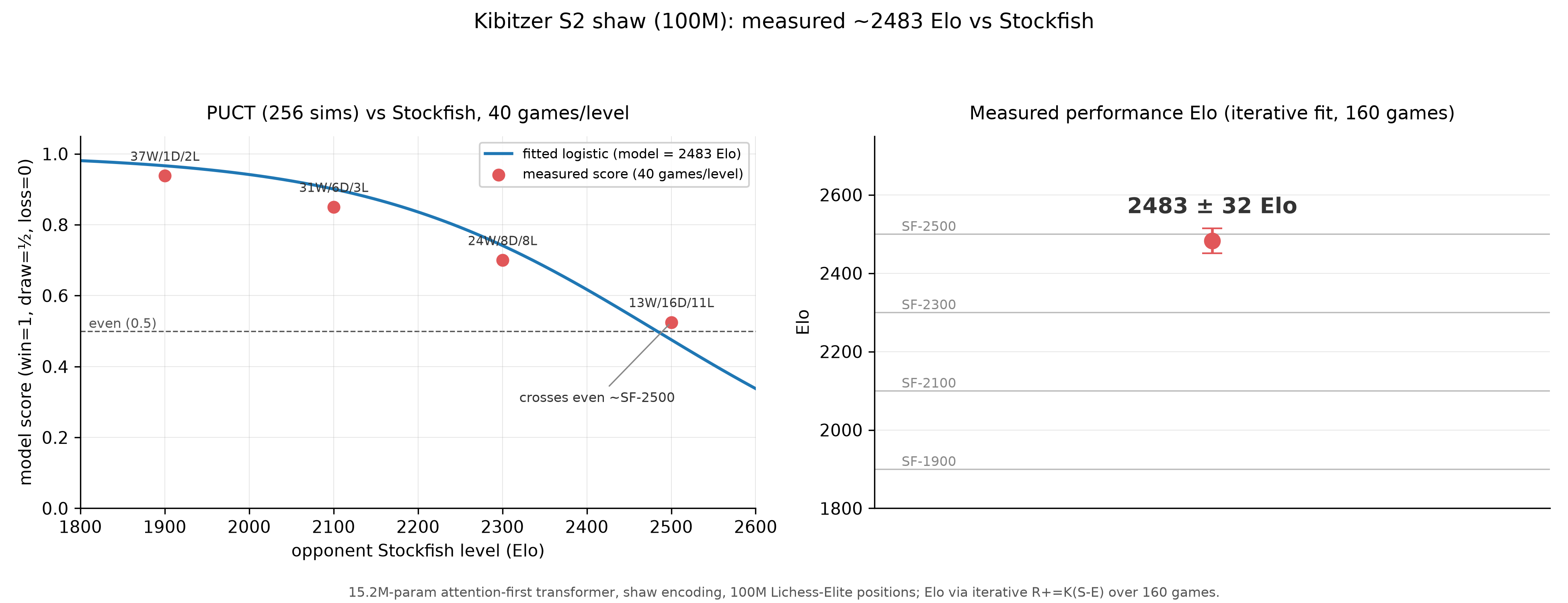
| searchless-ladder Elo | 2483 ± 32 (64-sim PUCT vs Stockfish UCI_Elo ladder) |
| hardware | one RTX 4060 laptop, 8 GB VRAM |
| base checkpoint | Pradheep1647/kibitzer-s2-shaw-142m-comp |
| code + full lab notebook | github.com/Mantissagithub/kibitzer |
Intended use
Kibitzer is a research artifact: a study of how far a small model can be pushed at chess on consumer hardware. Use it to analyze a position and get a move (as an engine wrapped in PUCT search), to reproduce the evaluations, or as a base for further chess policy/value research. It is not a drop-in UCI engine binary, though a UCI wrapper is provided in the repo (scripts/uci_engine.py).
Architecture
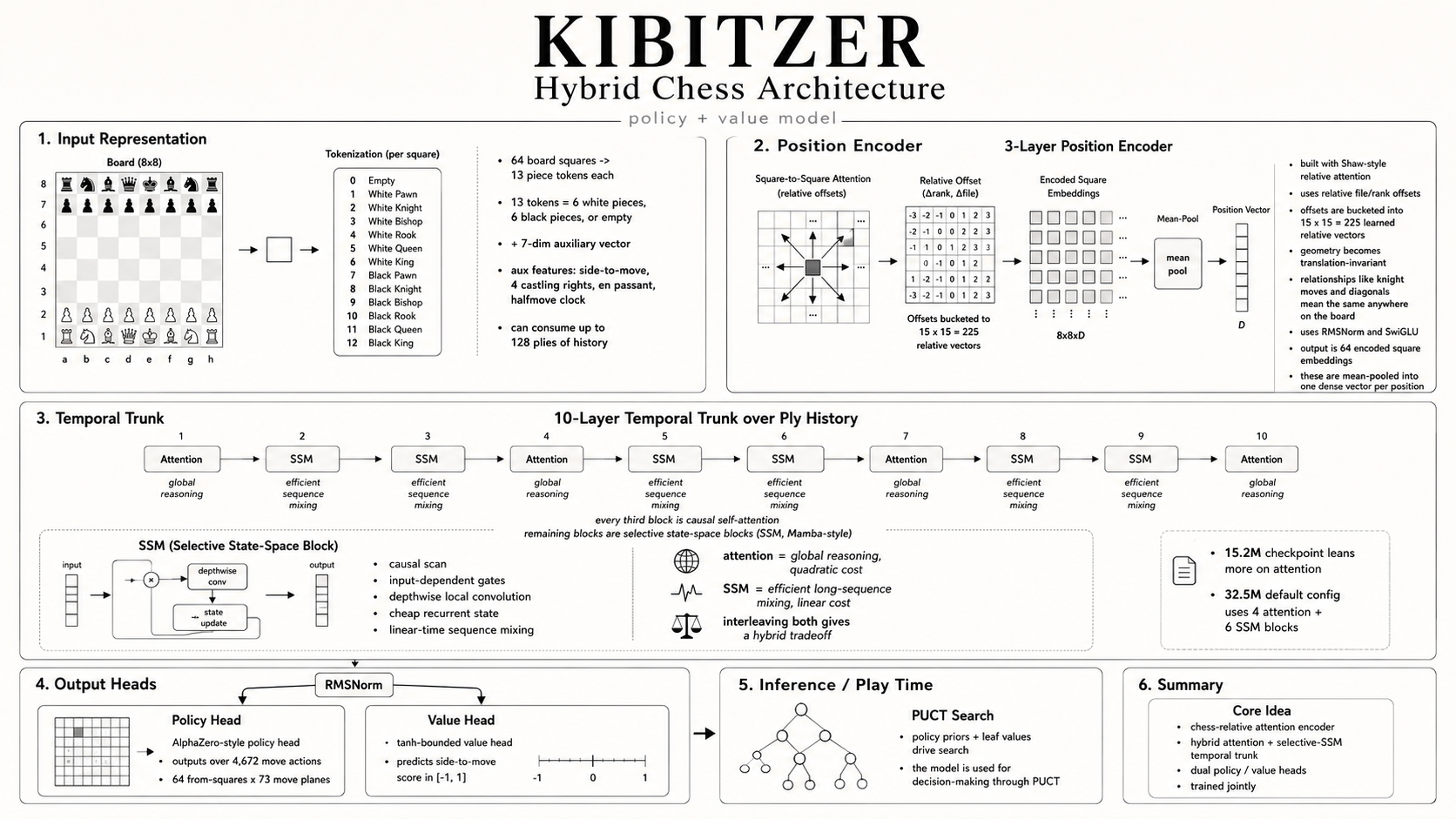
A position is fed as structured chess state, not pixels or a move list: each of the 64 squares becomes one of 13 piece tokens, alongside a 7-dim auxiliary vector (side-to-move, four castling rights, en passant, halfmove clock). The model can also consume up to 128 plies of history.
The board first passes through a 3-layer position encoder built on Shaw-style relative attention: every pair of squares attends through its file and rank offset, bucketed into 15x15 = 225 learned relative vectors folded into the attention bias, which makes the geometry translation-invariant (a knight-move relationship means the same thing anywhere on the board). The 64 encoded squares are mean-pooled into one dense vector per position.
Those vectors flow into a 10-layer temporal trunk over the ply history that interleaves two block types: every third block is causal self-attention (global reasoning), the rest are selective state-space blocks (SSM, Mamba-style: causal scan, input-dependent gates, depthwise convolution, cheap linear-time state). Attention is powerful but quadratic, SSM is cheap and linear, so the trunk pays full-attention cost only where it earns its keep. An RMSNorm then feeds two heads: an AlphaZero-style policy over the fixed 4,672-move action space and a tanh-bounded value head. RMSNorm and SwiGLU are used throughout.
Evaluation
Official tournament Elo, Ordo-rated over 171 clean games against a Stockfish UCI_Elo ladder, both colors, model wrapped in 512-sim PUCT, anchored SF-2500 = 2500:
| player | rating | error | games | score % |
|---|---|---|---|---|
| SF-3100 | 2979.1 | 207.1 | 32 | 91 |
| SF-2900 | 2857.7 | 164.3 | 35 | 83 |
| SF-2700 | 2660.8 | 138.5 | 36 | 61 |
| Kibitzer @ 512 sims | 2581.6 | 102.3 | 171 | 42 |
| SF-2500 (anchor) | 2500.0 | ---- | 35 | 39 |
| SF-2200 | 2318.0 | 158.8 | 33 | 18 |
It crushes SF-2200 and SF-2500, loses to SF-2700 and above, with the 50% crossover near SF-2600. This is the strength of the model with search: deep PUCT does real work that does not distill back into the raw weights.
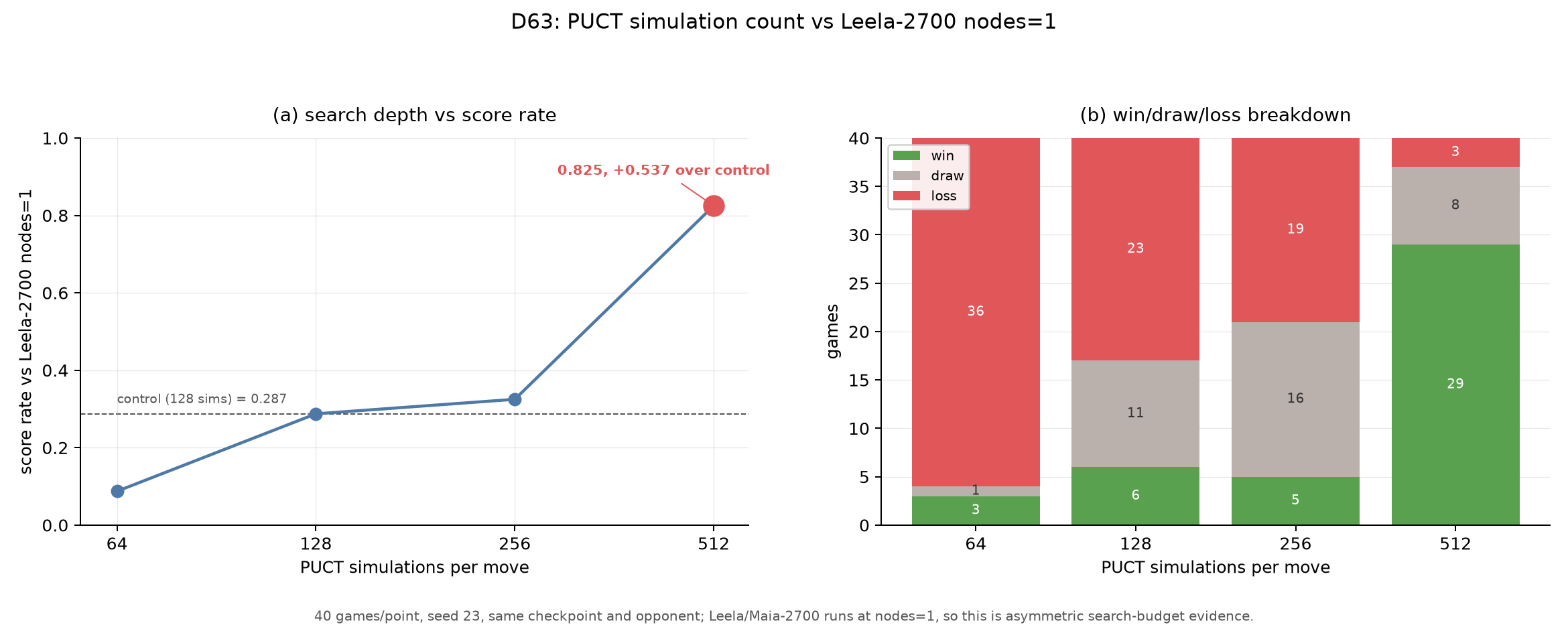
Search is the single largest inference-time lever. On the same checkpoint versus a fixed Leela/Maia-2700 proxy, only changing simulation count:
| sims | score vs 2700 proxy |
|---|---|
| 64 | 0.087 |
| 128 | 0.287 |
| 256 | 0.325 |
| 512 | 0.825 |
How to use
Kibitzer is a custom architecture, so you need the kibitzer package from the GitHub repo, not transformers.
import chess
from huggingface_hub import hf_hub_download
from kibitzer.inference import ModelEvaluator
from kibitzer.search import puct_search

ckpt = hf_hub_download("Pradheep1647/kibitzer-tactical-repair", "tactical_repair.pt")
evaluator = ModelEvaluator.from_checkpoint(ckpt, device="cuda")

board = chess.Board()
result = puct_search(board, evaluator, simulations=512)
print(result.move)          # best move
print(result.root_value)    # side-to-move value estimate
Limitations and honest caveats
- The 2581 Elo is a with-search, compute-asymmetric match statistic, not an intrinsic raw-weights rating. The Stockfish
UCI_Eloladder is an internal relative scale, not FIDE. The ±102 interval is wide (171 games across five opponents). - The value head is the weak link: 33k parameters bolted onto a 15M trunk, correct in sign but noisy and late. Enlarging it improved offline metrics and hurt play.
- Strength plateaus around 2500-2600. Nine separate post-training directions (self-play, expert iteration, on-policy distillation, TD-Leaf, GRPO/DPPO RL, preference optimization, process-reward repair) were tried to break past it. All nine held or lost strength against a fixed external opponent. The ceiling, it turns out, is remarkably committed to being a ceiling.
- The only lever left with a positive slope is parameter and data scale, which is a deliberate not-now: the point of the project was the ceiling of a small model on a laptop.
Provenance
- Base:
Pradheep1647/kibitzer-s2-shaw-142m-comp(S2 Shaw, 14.9M params, 142M Lichess Elite positions). - This checkpoint: a competition/puzzle supervised tactical repair (
tactical_supervised_repair_r1_policy_only) on top ofpolicy_regret_repair.pt, promoted as the strongest branch that survived a paired external gate. - Full decision-by-decision history, including every failed experiment, is in the project LOGBOOK.md.
Citation
@software{kibitzer2026,
  author  = {Pradheep},
  title   = {Kibitzer: a 15M-parameter chess policy/value model trained on a laptop},
  year    = {2026},
  url     = {https://github.com/Mantissagithub/kibitzer}
}