mutual information Contrastive Sentence Embedding (miCSE) for Low-shot Sentence Embeddings
Paper accepted at ACL 2023

Brief Model Description
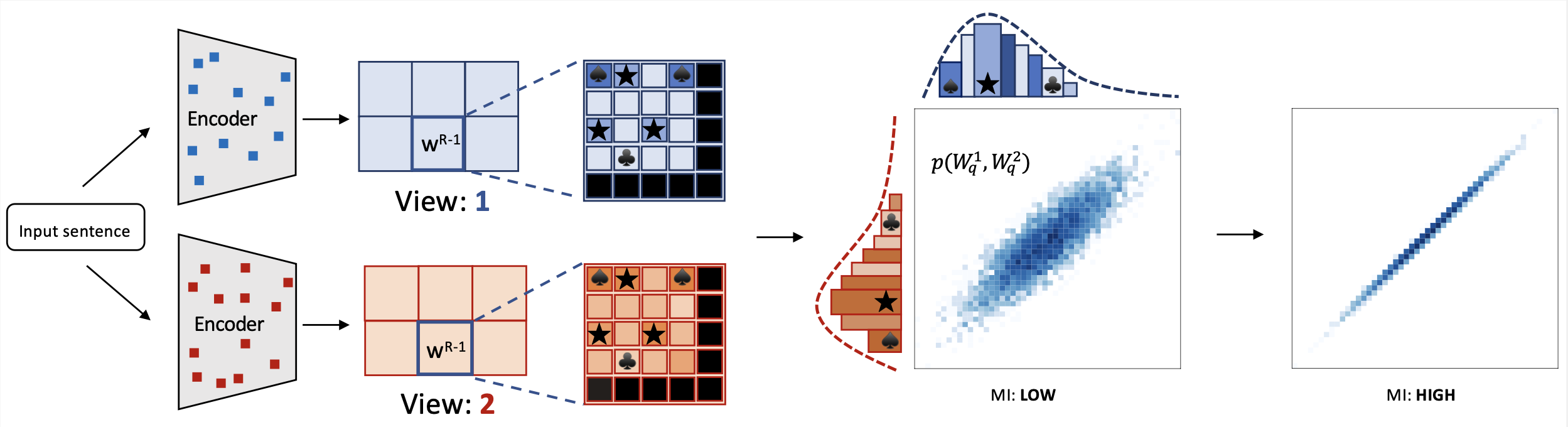 The miCSE language model is trained for sentence similarity computation. Training the model imposes alignment between the attention pattern of different views (embeddings of augmentations) during contrastive learning. Intuitively, learning sentence embeddings with miCSE entails enforcing syntactic consistency across dropout augmented views. Practically, this is achieved by regularizing the self-attention distribution. By regularizing self-attention during training, representation learning becomes much more sample efficient. Hence, self-supervised learning becomes tractable even when the training set is limited in size. This property makes miCSE particularly interesting for real-world applications, where training data is typically limited.
Model Use Cases
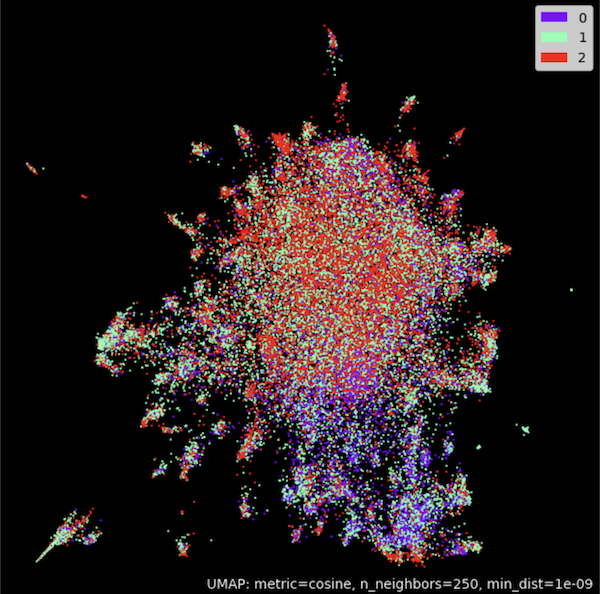
The model intended to be used for encoding sentences or short paragraphs. Given an input text, the model produces a vector embedding capturing the semantics. Sentence representations correspond to embedding of the [CLS] token. The embedding can be used for numerous tasks such as retrieval,sentence similarity comparison (see example 1) or clustering (see example 2).
Training data
The model was trained on a random collection of English sentences from Wikipedia. The full-shot training file is available here. Low-shot training data consists of data splits of different sizes (from 10% to 0.0064%) of the SimCSE training corpus. Each split size comprises 5 files, created with a different seed indicated with filename postfix. Data can be downloaded here.
Model Training
In order to make use of the few-shot capability of miCSE, the mode needs to be trained on your data. The source code and data splits used in the paper are available here.
Training Data
Model Usage
Example 1) - Sentence Similarity
from transformers import AutoTokenizer, AutoModel
import torch.nn as nn

tokenizer = AutoTokenizer.from_pretrained("sap-ai-research/miCSE")

model = AutoModel.from_pretrained("sap-ai-research/miCSE")

# Encoding of sentences in a list with a predefined maximum lengths of tokens (max_length)

max_length = 32

sentences = [
    "This is a sentence for testing miCSE.",
    "This is yet another test sentence for the mutual information Contrastive Sentence Embeddings model."
]

batch = tokenizer.batch_encode_plus(
                sentences,
                return_tensors='pt',
                padding=True,
                max_length=max_length,
                truncation=True
            )

# Compute the embeddings and keep only the _**[CLS]**_ embedding (the first token)

# Get raw embeddings (no gradients)
with torch.no_grad():
    outputs = model(**batch, output_hidden_states=True, return_dict=True)

embeddings = outputs.last_hidden_state[:,0]

# Define similarity metric, e.g., cosine similarity

sim = nn.CosineSimilarity(dim=-1)

# Compute similarity between the **first** and the **second** sentence

cos_sim = sim(embeddings.unsqueeze(1),
             embeddings.unsqueeze(0))

print(f"Distance: {cos_sim[0,1].detach().item()}")
Example 2) - Clustering
from transformers import AutoTokenizer, AutoModel
import torch.nn as nn
import torch
import numpy as np
import tqdm
from datasets import load_dataset
import umap
import umap.plot as umap_plot

# Determine available hardware
if torch.backends.mps.is_available():
    device = torch.device("mps")
elif torch.cuda.is_available():
    device = torch.device("cuda")
else:
    device = torch.device("cpu")

# Load tokenizer and model
tokenizer = AutoTokenizer.from_pretrained("/Users/d065243/miCSE")
model = AutoModel.from_pretrained("/Users/d065243/miCSE")
model.to(device);

# Load Twitter data for sentiment clustering
dataset = load_dataset("tweet_eval", "sentiment")


# Compute embeddings of the tweets

# set batch size and maxium tweet token length
batch_size = 50
max_length = 128

iterations = int(np.floor(len(dataset['train'])/batch_size))*batch_size

embedding_stack = []
classes = []
for i in tqdm.notebook.tqdm(range(0,iterations,batch_size)):
    # create batch
    batch = tokenizer.batch_encode_plus(
                    dataset['train'][i:i+batch_size]['text'],
                    return_tensors='pt',
                    padding=True,
                    max_length=max_length,
                    truncation=True
                ).to(device)
    classes = classes + dataset['train'][i:i+batch_size]['label']

    # model inference without gradient
    with torch.no_grad():
        outputs = model(**batch, output_hidden_states=True, return_dict=True)

        embeddings = outputs.last_hidden_state[:,0]


        embedding_stack.append( embeddings.cpu().clone() )

embeddings = torch.vstack(embedding_stack)


# Cluster embeddings in 2D with UMAP
umap_model = umap.UMAP(n_neighbors=250,
                    n_components=2,
                    min_dist=1.0e-9,
                    low_memory=True,
                    angular_rp_forest=True,
                    metric='cosine')
umap_model.fit(embeddings)

# Plot result
umap_plot.points(umap_model, labels = np.array(classes),theme='fire')
Example 3) - Using SentenceTransformers
from sentence_transformers import SentenceTransformer, util
from sentence_transformers import models
import torch.nn as nn

# Using the model with [CLS] embeddings
model_name = 'sap-ai-research/miCSE'
word_embedding_model = models.Transformer(model_name, max_seq_length=32)
pooling_model = models.Pooling(word_embedding_model.get_word_embedding_dimension())
model = SentenceTransformer(modules=[word_embedding_model, pooling_model])

# Using cosine similarity as metric
cos_sim = nn.CosineSimilarity(dim=-1)

# List of sentences for comparison
sentences_1 = ["This is a sentence for testing miCSE.",
    "This is using mutual information Contrastive Sentence Embeddings model."]

sentences_2 = ["This is testing miCSE.",
    "Similarity with miCSE"]

# Compute embedding for both lists
embeddings_1 = model.encode(sentences_1, convert_to_tensor=True)
embeddings_2 = model.encode(sentences_2, convert_to_tensor=True)

# Compute cosine similarities
cosine_sim_scores = cos_sim(embeddings_1, embeddings_2)

#Output of results
for i in range(len(sentences1)):
    print(f"Similarity {cosine_scores[i][i]:.2f}: {sentences1[i]} << vs. >> {sentences2[i]}")
Benchmark
Model results on SentEval Benchmark:
+-------+-------+-------+-------+-------+--------------+-----------------+--------+
| STS12 | STS13 | STS14 | STS15 | STS16 | STSBenchmark | SICKRelatedness | S.Avg. |
+-------+-------+-------+-------+-------+--------------+-----------------+--------+
| 71.71 | 83.09 | 75.46 | 83.13 | 80.22 |    79.70     |      73.62      | 78.13  |
+-------+-------+-------+-------+-------+--------------+-----------------+--------+
Citations
If you use this code in your research or want to refer to our work, please cite:
@inproceedings{klein-nabi-2023-micse,
    title = "mi{CSE}: Mutual Information Contrastive Learning for Low-shot Sentence Embeddings",
    author = "Klein, Tassilo  and
      Nabi, Moin",
    booktitle = "Proceedings of the 61st Annual Meeting of the Association for Computational Linguistics (Volume 1: Long Papers)",
    month = jul,
    year = "2023",
    address = "Toronto, Canada",
    publisher = "Association for Computational Linguistics",
    url = "https://aclanthology.org/2023.acl-long.339",
    pages = "6159--6177",
    abstract = "This paper presents miCSE, a mutual information-based contrastive learning framework that significantly advances the state-of-the-art in few-shot sentence embedding.The proposed approach imposes alignment between the attention pattern of different views during contrastive learning. Learning sentence embeddings with miCSE entails enforcing the structural consistency across augmented views for every sentence, making contrastive self-supervised learning more sample efficient. As a result, the proposed approach shows strong performance in the few-shot learning domain. While it achieves superior results compared to state-of-the-art methods on multiple benchmarks in few-shot learning, it is comparable in the full-shot scenario. This study opens up avenues for efficient self-supervised learning methods that are more robust than current contrastive methods for sentence embedding.",
}