SeaLLMs-Audio: Large Audio-Language Models for Southeast Asia
We introduce SeaLLMs-Audio, the multimodal (audio) extension of the SeaLLMs (Large Language Models for Southeast Asian languages) family. It is the first large audio-language model (LALM) designed to support multiple Southeast Asian languages, including Indonesian (id), Thai (th), and Vietnamese (vi), alongside English (en) and Chinese (zh).
Trained on a large-scale audio dataset, SeaLLMs-Audio demonstrates strong performance across various audio-related tasks, such as audio analysis tasks and voice-based interactions. As a significant step toward advancing audio LLMs in Southeast Asia, we hope SeaLLMs-Audio will benefit both the research community and industry in the region.
Key Features of SeaLLMs-Audio:
- Multilingual: The model mainly supports 5 languages, including 🇮🇩 Indonesian, 🇹🇭 Thai, 🇻🇳 Vietnamese, 🇬🇧 English, and 🇨🇳 Chinese.
- Multimodal: The model supports flexible input formats, such as audio only, text only, and audio with text.
- Multi-task: The model supports a variety of tasks, including audio analysis tasks such as audio captioning, automatic speech recognition, speech-to-text translation, speech emotion recognition, speech question answering, and speech summarization. Additionally, it handles voice chat tasks, including answering factual, mathematical, and other general questions.
We open-weight SeaLLMs-Audio on Hugging Face, and we have built a demo for users to interact with.
Training information:
SeaLLMs-Audio builts upon Qwen2-Audio-7B and Qwen2.5-7B-Instruct. We replaced the LLM module in Qwen2-Audio-7B by Qwen2.5-7B-Instruct. After that, we do full-parameter fine-tuning on a large-scale audio dataset. This dataset contains 1.58M conversations for multiple tasks, in which 93% are single turn. The tasks can be roughly classified as following task categories: automatic speech recognition (ASR), audio captioning (AC), speech-to-text translation (S2TT), question answering (QA), speech summarization (SS), speech question answering (SQA), chat, math, and fact and mixed tasks (mixed).
The distribution of data across languages and tasks are:
The training dataset was curated from multiple data sources, including public datasets and in-house data. Public datasets includes: gigaspeech, gigaspeech2, common voice, AudioCaps, VoiceAssistant-400K, YODAS2, and Multitask-National-Speech-Corpus. We would like to thank the authors of these datasets for their contributions to the community!
We train the model on the dataset for 1 epoch, which took ~6 days to complete on 32 A800 GPUs.
Performance
Due to the absence of standard audio benchmarks for evaluating audio LLMs in Southeast Asia, we have manually created a benchmark called SeaBench-Audio. It comprises nine tasks:
- Tasks with both audio and text inputs: Audio Captioning (AC), Automatic Speech Recognition (ASR), Speech-to-Text Translation (S2TT), Speech Emotion Recognition (SER), Speech Question Answering (SQA), and Speech Summarization (SS).
- Tasks with only audio inputs: Factuality, Math, and General.
We manually annotated 15 questions per task per language. For evaluation, qualified native speakers rated each response on a scale of 1 to 5, with 5 representing the highest quality.
Due to the lack of LALMs for all the three Southeast Asian languages, we compare the performance of SeaLLMs-Audio with relevant LALMs with similar sizes, including: Qwen2-Audio-7B-Instruct (Qwen2-Audio), MERaLiON-AudioLLM-Whisper-SEA-LION (MERaLiON), llama3.1-typhoon2-audio-8b-instruct (typhoon2-audio), and DiVA-llama-3-v0-8b (DiVA). All the LALMs can accept audio with text as input. The results are shown in the figure below.
Average scores of SeaLLMs-Audio vs. Other LALMs on SeaBench-Audio
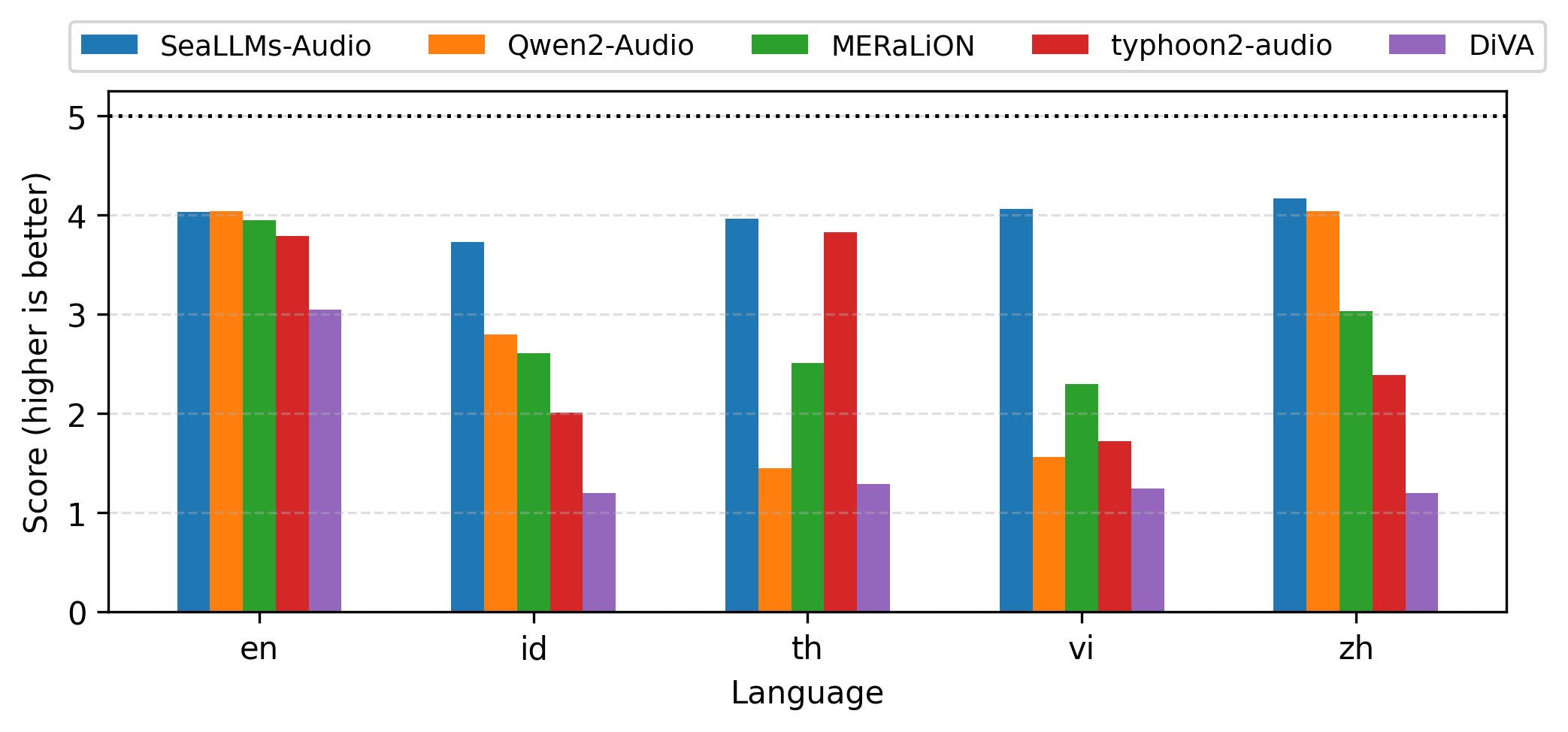
The results shows that SeaLLMs-Audio achieve state-of-the-art performance in all the five langauges, demonstrating its effectiveness in supporting audio-related tasks in Southeast Asia.
Quickstart
Our model is available on Hugging Face, and you can easily use it with the transformers library or vllm library. Below are some examples to get you started.
Get started with transformers
from transformers import Qwen2AudioForConditionalGeneration, AutoProcessor
import librosa
import os

model = Qwen2AudioForConditionalGeneration.from_pretrained("SeaLLMs/SeaLLMs-Audio-7B", device_map="auto")
processor = AutoProcessor.from_pretrained("SeaLLMs/SeaLLMs-Audio-7B")

def response_to_audio(conversation, model=None, processor=None):
    text = processor.apply_chat_template(conversation, add_generation_prompt=True, tokenize=False)
    audios = []
    for message in conversation:
        if isinstance(message["content"], list):
            for ele in message["content"]:
                if ele["type"] == "audio":
                    if ele['audio_url'] != None:
                        audios.append(librosa.load(
                            ele['audio_url'],
                            sr=processor.feature_extractor.sampling_rate)[0]
                        )
    if audios != []:
        inputs = processor(text=text, audios=audios, return_tensors="pt", padding=True,sampling_rate=16000)
    else:
        inputs = processor(text=text, return_tensors="pt", padding=True)
    inputs.input_ids = inputs.input_ids.to("cuda")
    inputs = {k: v.to("cuda") for k, v in inputs.items() if v is not None}
    generate_ids = model.generate(**inputs, max_new_tokens=2048, temperature = 0, do_sample=False)
    generate_ids = generate_ids[:, inputs["input_ids"].size(1):]
    response = processor.batch_decode(generate_ids, skip_special_tokens=True, clean_up_tokenization_spaces=False)[0]
    return response

# Voice Chat
os.system(f"wget -O fact_en.wav https://DAMO-NLP-SG.github.io/SeaLLMs-Audio/static/audios/fact_en.wav")
os.system(f"wget -O general_en.wav https://DAMO-NLP-SG.github.io/SeaLLMs-Audio/static/audios/general_en.wav")
conversation = [
    {"role": "user", "content": [
        {"type": "audio", "audio_url": "fact_en.wav"},
    ]},
    {"role": "assistant", "content": "The most abundant gas in Earth's atmosphere is nitrogen. It makes up about 78 percent of the atmosphere by volume."},
    {"role": "user", "content": [
        {"type": "audio", "audio_url": "general_en.wav"},
    ]},
]

response = response_to_audio(conversation, model=model, processor=processor)
print(response)

# Audio Analysis
os.system(f"wget -O ASR_en.wav https://DAMO-NLP-SG.github.io/SeaLLMs-Audio/static/audios/ASR_en.wav")
conversation = [
    {"role": "user", "content": [
        {"type": "audio", "audio_url": "ASR_en.wav"},
        {"type": "text", "text": "Please write down what is spoken in the audio file."},
    ]},
]

response = response_to_audio(conversation, model=model, processor=processor)
print(response)
Inference with vllm
from vllm import LLM, SamplingParams
import librosa, os
from transformers import AutoProcessor

processor = AutoProcessor.from_pretrained("SeaLLMs/SeaLLMs-Audio-7B")
llm = LLM(
    model="SeaLLMs/SeaLLMs-Audio-7B", trust_remote_code=True, gpu_memory_utilization=0.5,
    enforce_eager=True,  device = "cuda",
    limit_mm_per_prompt={"audio": 5},
)

def response_to_audio(conversation, model=None, processor=None, temperature = 0.1,repetition_penalty=1.1, top_p = 0.9,max_new_tokens = 4096):
    text = processor.apply_chat_template(conversation, add_generation_prompt=True, tokenize=False)
    audios = []
    for message in conversation:
        if isinstance(message["content"], list):
            for ele in message["content"]:
                if ele["type"] == "audio":
                    if ele['audio_url'] != None:
                        audios.append(librosa.load(
                            ele['audio_url'],
                            sr=processor.feature_extractor.sampling_rate)[0]
                        )

    sampling_params = SamplingParams(
        temperature=temperature, max_tokens=max_new_tokens, repetition_penalty=repetition_penalty, top_p=top_p, top_k=20,
        stop_token_ids=[],
    )

    input = {
            'prompt': text,
            'multi_modal_data': {
                'audio': [(audio, 16000) for audio in audios]
            }
            }

    output = model.generate([input], sampling_params=sampling_params)[0]
    response = output.outputs[0].text
    return response

# Voice Chat
os.system(f"wget -O fact_en.wav https://DAMO-NLP-SG.github.io/SeaLLMs-Audio/static/audios/fact_en.wav")
os.system(f"wget -O general_en.wav https://DAMO-NLP-SG.github.io/SeaLLMs-Audio/static/audios/general_en.wav")
conversation = [
    {"role": "user", "content": [
        {"type": "audio", "audio_url": "fact_en.wav"},
    ]},
    {"role": "assistant", "content": "The most abundant gas in Earth's atmosphere is nitrogen. It makes up about 78 percent of the atmosphere by volume."},
    {"role": "user", "content": [
        {"type": "audio", "audio_url": "general_en.wav"},
    ]},
]

response = response_to_audio(conversation, model=llm, processor=processor)
print(response)

# Audio Analysis
os.system(f"wget -O ASR_en.wav https://DAMO-NLP-SG.github.io/SeaLLMs-Audio/static/audios/ASR_en.wav")
conversation = [
    {"role": "user", "content": [
        {"type": "audio", "audio_url": "ASR_en.wav"},
        {"type": "text", "text": "Please write down what is spoken in the audio file."},
    ]},
]

response = response_to_audio(conversation, model=llm, processor=processor)
print(response)
Citation
If you find our project useful, we hope you would kindly star our repo and cite our work as follows. Corresponding Author: Wenxuan Zhang (wxzhang@sutd.edu.sg)
@misc{SeaLLMs-Audio,
      title={SeaLLMs-Audio: Large Audio-Language Models for Southeast Asia},
      author={Chaoqun Liu and Mahani Aljunied and Guizhen Chen and Hou Pong Chan and Weiwen Xu and Yu Rong and Wenxuan Zhang},
      year={2025},
      eprint={2511.01670},
      archivePrefix={arXiv},
      url={https://arxiv.org/abs/2511.01670},
}