Data2Vec-Vision (base-sized model, pre-trained only)
BEiT model pre-trained in a self-supervised fashion on ImageNet-1k (1,2 million images, 1000 classes) at resolution 224x224. It was introduced in the paper data2vec: A General Framework for Self-supervised Learning in Speech, Vision and Language by Alexei Baevski, Wei-Ning Hsu, Qiantong Xu, Arun Babu, Jiatao Gu, Michael Auli and first released in this repository.
Disclaimer: The team releasing Facebook team did not write a model card for this model so this model card has been written by the Hugging Face team.
Pre-Training method
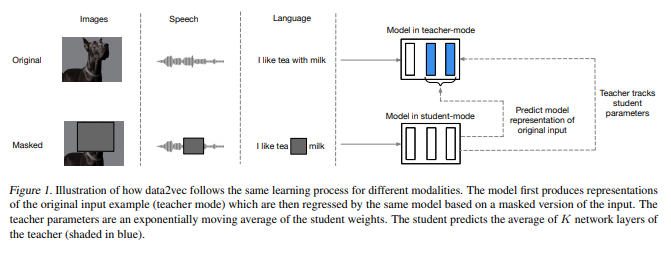
For more information, please take a look at the official paper.
Abstract
While the general idea of self-supervised learning is identical across modalities, the actual algorithms and objectives differ widely because they were developed with a single modality in mind. To get us closer to general self-supervised learning, we present data2vec, a framework that uses the same learning method for either speech, NLP or computer vision. The core idea is to predict latent representations of the full input data based on a masked view of the input in a selfdistillation setup using a standard Transformer architecture. Instead of predicting modality-specific targets such as words, visual tokens or units of human speech which are local in nature, data2vec predicts contextualized latent representations that contain information from the entire input. Experiments on the major benchmarks of speech recognition, image classification, and natural language understanding demonstrate a new state of the art or competitive performance to predominant approaches.
Intended uses & limitations
You can use the raw model for image classification. See the model hub to look for fine-tuned versions on a task that interests you.
Training data
The BEiT model was pretrained on ImageNet-1k, a dataset consisting of 1,2 million images and 1k classes.
Training procedure
Preprocessing
The exact details of preprocessing of images during training/validation can be found here.
Images are resized/rescaled to the same resolution (224x224) and normalized across the RGB channels with mean (0.5, 0.5, 0.5) and standard deviation (0.5, 0.5, 0.5).
Pretraining
For all pre-training related hyperparameters, we refer to the original paper and the original codebase
Evaluation results
For evaluation results on several image classification benchmarks, we refer to tables 1 of the original paper. Note that for fine-tuning, the best results are obtained with a higher resolution. Of course, increasing the model size will result in better performance.
BibTeX entry and citation info
@misc{https://doi.org/10.48550/arxiv.2202.03555,
  doi = {10.48550/ARXIV.2202.03555},
  url = {https://arxiv.org/abs/2202.03555},
  author = {Baevski, Alexei and Hsu, Wei-Ning and Xu, Qiantong and Babu, Arun and Gu, Jiatao and Auli, Michael},
  keywords = {Machine Learning (cs.LG), FOS: Computer and information sciences, FOS: Computer and information sciences},
  title = {data2vec: A General Framework for Self-supervised Learning in Speech, Vision and Language},
  publisher = {arXiv},
  year = {2022},
  copyright = {arXiv.org perpetual, non-exclusive license}
}