ProPainter ONNX
ONNX builds of ProPainter, made by Moonbox for on-device use with ONNX Runtime (CPU, CUDA, DirectML). Each
precision is one folder holding the graphs and a small Python pipeline.py that does the rest (image preprocessing,
the frame loop, mask handling); what the graphs take and return is under How to run.
Files
The last column is the benchmark against the original PyTorch model (details under How to run): how closely each output frame matches the original's on the same clips and masks.
| Precision | File | Size | sha256 | Benchmark |
|---|---|---|---|---|
| fp16 | fp16/fc_decoder.onnx | 0.6 MB | 48750e6e2291 | inpainted-region PSNR vs the original: mean 52.8 / 54.4 dB, worst frame 43.6 dB; 20.9 / 17.1 s per clip (CUDA; original 39 / 30 s) |
| fp16 | fp16/fc_encoder.onnx | 1.3 MB | 269ee000d9d5 | inpainted-region PSNR vs the original: mean 52.8 / 54.4 dB, worst frame 43.6 dB; 20.9 / 17.1 s per clip (CUDA; original 39 / 30 s) |
| fp16 | fp16/fc_step_backward.onnx | 7.9 MB | cf55f6d4fa1d | inpainted-region PSNR vs the original: mean 52.8 / 54.4 dB, worst frame 43.6 dB; 20.9 / 17.1 s per clip (CUDA; original 39 / 30 s) |
| fp16 | fp16/fc_step_forward.onnx | 8.5 MB | 338b54350aac | inpainted-region PSNR vs the original: mean 52.8 / 54.4 dB, worst frame 43.6 dB; 20.9 / 17.1 s per clip (CUDA; original 39 / 30 s) |
| fp16 | fp16/gen_encoder.onnx | 8.4 MB | 29bcde1a374d | inpainted-region PSNR vs the original: mean 52.8 / 54.4 dB, worst frame 43.6 dB; 20.9 / 17.1 s per clip (CUDA; original 39 / 30 s) |
| fp16 | fp16/gen_step_backward.onnx | 6.8 MB | a3e60860c293 | inpainted-region PSNR vs the original: mean 52.8 / 54.4 dB, worst frame 43.6 dB; 20.9 / 17.1 s per clip (CUDA; original 39 / 30 s) |
| fp16 | fp16/gen_step_forward.onnx | 6.8 MB | f33655516654 | inpainted-region PSNR vs the original: mean 52.8 / 54.4 dB, worst frame 43.6 dB; 20.9 / 17.1 s per clip (CUDA; original 39 / 30 s) |
| fp16 | fp16/gen_transformer.onnx | 66.6 MB | e4d7aec32f7f | inpainted-region PSNR vs the original: mean 52.8 / 54.4 dB, worst frame 43.6 dB; 20.9 / 17.1 s per clip (CUDA; original 39 / 30 s) |
| fp16 | fp16/img_step.onnx | 17.8 kB | 49973fad918f | inpainted-region PSNR vs the original: mean 52.8 / 54.4 dB, worst frame 43.6 dB; 20.9 / 17.1 s per clip (CUDA; original 39 / 30 s) |
| fp16 | fp16/pipeline.py | 13.3 kB | 608ba7424349 | inpainted-region PSNR vs the original: mean 52.8 / 54.4 dB, worst frame 43.6 dB; 20.9 / 17.1 s per clip (CUDA; original 39 / 30 s) |
| fp16 | fp16/raft.onnx | 21.6 MB | 2b8b0cb0b202 | inpainted-region PSNR vs the original: mean 52.8 / 54.4 dB, worst frame 43.6 dB; 20.9 / 17.1 s per clip (CUDA; original 39 / 30 s) |
| int8 | int8/fc_decoder.onnx | 0.3 MB | d1053b01b442 | weight-only int8: inpainted-region PSNR mean 42.2 / 43.5 dB, worst frame 35.8 dB; 23.7 / 20.5 s per clip (CUDA) |
| int8 | int8/fc_encoder.onnx | 0.7 MB | 949766e8c135 | weight-only int8: inpainted-region PSNR mean 42.2 / 43.5 dB, worst frame 35.8 dB; 23.7 / 20.5 s per clip (CUDA) |
| int8 | int8/fc_step_backward.onnx | 2.9 MB | c8f887385659 | weight-only int8: inpainted-region PSNR mean 42.2 / 43.5 dB, worst frame 35.8 dB; 23.7 / 20.5 s per clip (CUDA) |
| int8 | int8/fc_step_forward.onnx | 3.0 MB | 73071dbb750b | weight-only int8: inpainted-region PSNR mean 42.2 / 43.5 dB, worst frame 35.8 dB; 23.7 / 20.5 s per clip (CUDA) |
| int8 | int8/gen_encoder.onnx | 4.2 MB | e69ecdc695b2 | weight-only int8: inpainted-region PSNR mean 42.2 / 43.5 dB, worst frame 35.8 dB; 23.7 / 20.5 s per clip (CUDA) |
| int8 | int8/gen_step_backward.onnx | 2.2 MB | dc50acb1ea89 | weight-only int8: inpainted-region PSNR mean 42.2 / 43.5 dB, worst frame 35.8 dB; 23.7 / 20.5 s per clip (CUDA) |
| int8 | int8/gen_step_forward.onnx | 2.2 MB | d17994ba880e | weight-only int8: inpainted-region PSNR mean 42.2 / 43.5 dB, worst frame 35.8 dB; 23.7 / 20.5 s per clip (CUDA) |
| int8 | int8/gen_transformer.onnx | 34.8 MB | 551d2cedd7d8 | weight-only int8: inpainted-region PSNR mean 42.2 / 43.5 dB, worst frame 35.8 dB; 23.7 / 20.5 s per clip (CUDA) |
| int8 | int8/img_step.onnx | 17.8 kB | 49973fad918f | weight-only int8: inpainted-region PSNR mean 42.2 / 43.5 dB, worst frame 35.8 dB; 23.7 / 20.5 s per clip (CUDA) |
| int8 | int8/pipeline.py | 13.3 kB | 608ba7424349 | weight-only int8: inpainted-region PSNR mean 42.2 / 43.5 dB, worst frame 35.8 dB; 23.7 / 20.5 s per clip (CUDA) |
| int8 | int8/raft.onnx | 5.9 MB | 1ab239cd357d | weight-only int8: inpainted-region PSNR mean 42.2 / 43.5 dB, worst frame 35.8 dB; 23.7 / 20.5 s per clip (CUDA) |
How to run
ProPainter (S-Lab, NTU: video inpainting and object removal from per-frame masks) as ten ONNX graphs plus
pipeline.py, a numpy runtime that reproduces the repository's inference_propainter.py (video inpainting mode, its
defaults) around them. Non-commercial use only (S-Lab License 1.0, below).
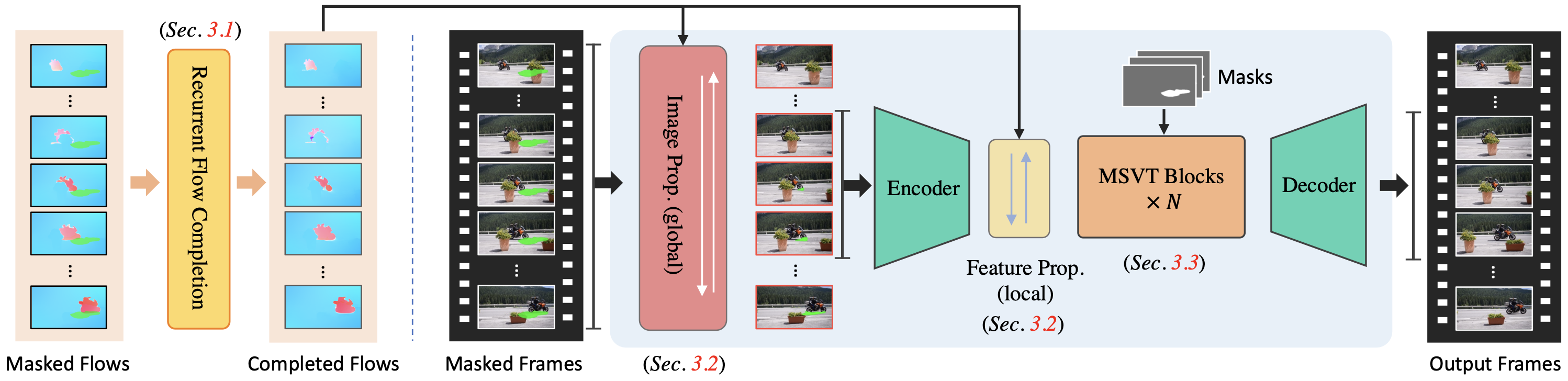
ProPainter works in three stages: optical flow between frames (RAFT), flow completion inside the masked regions,
then a generator that propagates pixels and features along the completed flow and fills the rest with a temporal
sparse transformer. The recurrent passes over frames are exported one step per graph; pipeline.py runs the loops.
raft.onnx:image1,image2[N, 3, H, W] in [-1, 1] ->flow[N, 2, H, W] (20 refinement iterations).- Flow completion:
fc_encoder.onnx: maskedflows[1, T, 2, H, W] andmasks[1, T, 1, H, W] -> features at 1/8 and 1/4 scale.fc_step_backward.onnx/fc_step_forward.onnx: one frame of its second-order deformable propagation.fc_decoder.onnx: fusion and decoder -> completed flow [T, 2, H, W].
img_step.onnx: one frame of the image propagation (flow warping with a forward-backward consistency check; no learned weights).- Generator:
gen_encoder.onnx: frames, masks and updated masks [t, ...] -> features [t, 128, H/4, W/4].gen_step_backward.onnx/gen_step_forward.onnx: one frame of its deformable feature propagation.gen_transformer.onnx: fusion, the temporal sparse transformer and the decoder -> frames [l_t, 3, H, W].
All graphs take any frame size that is a multiple of 8. pipeline.py resizes other sizes down to the nearest one,
as the original does.
pipeline.py reproduces the original's steps:
- Masks: dilated by 4 pixels, for flow and for inpainting.
- Flow: RAFT in short clips (12 frames up to 640 px wide). Flow completion in sub-videos of 80.
- Propagation: image propagation in sub-videos of 100.
- Generator: windows of 11 neighbouring frames plus reference frames every 10th frame; overlapping windows are averaged.
- Output: inpainted pixels composited back into the input frames.
It needs numpy, scipy, onnxruntime (or onnxruntime-gpu) and Pillow:
import sys
from PIL import Image
from pathlib import Path
sys.path.insert(0, "fp16")
import pipeline
pp = pipeline.ProPainter("fp16", "cuda")
frames = [Image.open(p).convert("RGB") for p in sorted(Path("clip").iterdir())]
masks = [Image.open(p) for p in sorted(Path("clip_mask").iterdir())]     # white = remove; or a single mask image
out = pp(frames, masks)                                                  # list of uint8 RGB frames
Or from the command line: python fp16/pipeline.py clip_frames/ clip_masks/ out/ --cuda. The repository's video
outpainting mode isn't ported. On Windows, give CUDA sessions the run option memory.enable_memory_arena_shrinkage =
gpu:0, as pipeline.py does.
How the graphs differ from the PyTorch modules (same arithmetic).
- Deformable convolutions are written as GridSample per kernel tap plus a MatMul. ONNX Runtime 1.23 has no DeformConv kernel. This form matches torchvision's to 3e-6.
- The sparse transformer picks attention per window with a data-dependent loop. In the graph, both attention kinds are computed for every window and selected with the window mask.
- Its fold step is a grouped transposed convolution.
- Sizes are computed from the input shape, so any frame size works.
Running the exported loop with the original PyTorch modules reproduces the original's frames to 81 dB PSNR.
Precisions.
fp16/: the encoders, decoders and the transformer in fp16 math (fp32 inputs / outputs). RAFT and the per-frame step graphs stay fp32: their weights are small, and ONNX Runtime's CUDA provider runs fp16 GridSample on the CPU (RAFT took 1.1 s per call instead of 79 ms).int8/: weight-only int8 (per output channel) on every network's convolutions and matmuls.img_stephas no weights and stays fp32 in both.- No bf16 (fp16 passes) and no int4: this is a convolutional network, and 4-bit MatMulNBits would cover only the transformer.
Benchmark.
- Clips: the repository's two sample clips with their masks (object removal): bmx-trees (80 frames) and tennis (70 frames), 432 x 240.
- Original:
inference_propainter.pyin fp32 on CUDA with its defaults. - Score: PSNR of every output frame against the original's, over the dilated mask, i.e. the inpainted pixels (outside it both copy the input). Mean over frames, and the worst frame.
- Pass mark: at least 30 dB on every frame.
- Timing: seconds per clip on an RTX 3080 Laptop GPU (16 GB), whole pipeline including RAFT.
| inpainted region, bmx-trees: mean / worst | tennis: mean / worst | seconds per clip | |
|---|---|---|---|
| original (PyTorch fp32, CUDA) | - | - | 39 / 30 |
| ONNX graphs in fp32 (not published) | 58.2 / 49.0 dB | 58.7 / 50.4 dB | 25 / 21 |
fp16/ (CUDA) | 52.8 / 43.6 dB | 54.4 / 49.5 dB | 21 / 17 |
int8/ (CUDA) | 42.2 / 35.8 dB | 43.5 / 39.1 dB | 24 / 21 |
Both builds remove the objects the same way the original does. Side by side, the int8 frames are indistinguishable from the original's.
Before the benchmark, each graph was checked against its PyTorch module (largest absolute difference, float32), at a frame size and frame count other than those it was exported at:
- The flow completion and generator graphs: at most 7e-5.
- The image propagation step: exact.
- RAFT: 2e-4 to 1e-3 on flows of about 3 pixels.
How these were made
From ProPainter at revision 326782529a. The graphs were exported from the original PyTorch modules with
torch.onnx (opset 17 / 18) and checked against them. Weight-only quantization: int8 is a per-output-channel int8
weight behind DequantizeLinear, int4 is ONNX Runtime's MatMulNBits (block 32). Each card above says which precision
every graph uses. Every precision was benchmarked against the original before upload (the pass mark is under How to run), and the
sha256 column above is what the files must hash to.
License
S-Lab License 1.0 (non-commercial). These files are a derivative of the original model and carry its license: it is copied in this repository, and it governs your use of these files. The original model card follows unchanged.
Original model card
⭐ If ProPainter is helpful to your projects, please help star this repo. Thanks! 🤗
:open_book: For more visual results, go checkout our project page
Update
- 2026.10.27: Our Hugging Face demo now supports SAM 2.1 for interactive video segmentation. Try the updated demo! 🤗
- 2023.11.09: Integrated to :man_artist: OpenXLab. Try out online demo!
- 2023.11.09: Integrated to :hugs: Hugging Face. Try out online demo!
- 2023.09.24: We remove the watermark removal demos officially to prevent the misuse of our work for unethical purposes.
- 2023.09.21: Add features for memory-efficient inference. Check our GPU memory requirements. 🚀
- 2023.09.07: Our code and model are publicly available. 🐳
- 2023.09.01: This repo is created.


TODO
- Make a Colab demo.
-
Make a interactive Gradio demo. -
Update features for memory-efficient inference.
Results
👨🏻🎨 Object Removal
🎨 Video Completion
Overview
Dependencies and Installation
-
Clone Repo
git clone https://github.com/sczhou/ProPainter.git -
Create Conda Environment and Install Dependencies
# create new anaconda env conda create -n propainter python=3.8 -y conda activate propainter # install python dependencies pip3 install -r requirements.txt- CUDA >= 9.2
- PyTorch >= 1.7.1
- Torchvision >= 0.8.2
- Other required packages in
requirements.txt
Get Started
Prepare pretrained models
Download our pretrained models from Releases V0.1.0 to the weights folder. (All pretrained models can also be automatically downloaded during the first inference.)
The directory structure will be arranged as:
weights
   |- ProPainter.pth
   |- recurrent_flow_completion.pth
   |- raft-things.pth
   |- i3d_rgb_imagenet.pt (for evaluating VFID metric)
   |- README.md
🏂 Quick test
We provide some examples in the inputs folder.
Run the following commands to try it out:
# The first example (object removal)
python inference_propainter.py --video inputs/object_removal/bmx-trees --mask inputs/object_removal/bmx-trees_mask
# The second example (video completion)
python inference_propainter.py --video inputs/video_completion/running_car.mp4 --mask inputs/video_completion/mask_square.png --height 240 --width 432
The results will be saved in the results folder.
To test your own videos, please prepare the input mp4 video (or split frames) and frame-wise mask(s).
If you want to specify the video resolution for processing or avoid running out of memory, you can set the video size of --width and --height:
# process a 576x320 video; set --fp16 to use fp16 (half precision) during inference.
python inference_propainter.py --video inputs/video_completion/running_car.mp4 --mask inputs/video_completion/mask_square.png --height 320 --width 576 --fp16
💃🏻 Interactive Demo
We also provide an interactive demo for object removal, allowing users to select any object they wish to remove from a video. You can try the demo on Hugging Face or run it locally.
Please note that the demo's interface and usage may differ from the GIF animation above. For detailed instructions, refer to the user guide.
🚀 Memory-efficient inference
Video inpainting typically requires a significant amount of GPU memory. Here, we offer various features that facilitate memory-efficient inference, effectively avoiding the Out-Of-Memory (OOM) error. You can use the following options to reduce memory usage further:
- Reduce the number of local neighbors through decreasing the
--neighbor_length(default 10). - Reduce the number of global references by increasing the
--ref_stride(default 10). - Set the
--resize_ratio(default 1.0) to resize the processing video. - Set a smaller video size via specifying the
--widthand--height. - Set
--fp16to use fp16 (half precision) during inference. - Reduce the frames of sub-videos
--subvideo_length(default 80), which effectively decouples GPU memory costs and video length.
Blow shows the estimated GPU memory requirements for different sub-video lengths with fp32/fp16 precision:
| Resolution | 50 frames | 80 frames |
|---|---|---|
| 1280 x 720 | 28G / 19G | OOM / 25G |
| 720 x 480 | 11G / 7G | 13G / 8G |
| 640 x 480 | 10G / 6G | 12G / 7G |
| 320 x 240 | 3G / 2G | 4G / 3G |
Dataset preparation
The training and test split files are provided in datasets/<dataset_name>. For each dataset, you should place JPEGImages to datasets/<dataset_name>. Resize all video frames to size 432x240 for training. Unzip downloaded mask files to datasets.
The datasets directory structure will be arranged as: (Note: please check it carefully)
datasets
   |- davis
      |- JPEGImages_432_240
         |- <video_name>
            |- 00000.jpg
            |- 00001.jpg
      |- test_masks
         |- <video_name>
            |- 00000.png
            |- 00001.png
      |- train.json
      |- test.json
   |- youtube-vos
      |- JPEGImages_432_240
         |- <video_name>
            |- 00000.jpg
            |- 00001.jpg
      |- test_masks
         |- <video_name>
            |- 00000.png
            |- 00001.png
      |- train.json
      |- test.json
Training
Our training configures are provided in train_flowcomp.json (for Recurrent Flow Completion Network) and train_propainter.json (for ProPainter).
Run one of the following commands for training:
 # For training Recurrent Flow Completion Network
 python train.py -c configs/train_flowcomp.json
 # For training ProPainter
 python train.py -c configs/train_propainter.json
You can run the same command to resume your training.
To speed up the training process, you can precompute optical flow for the training dataset using the following command:
 # Compute optical flow for training dataset
 python scripts/compute_flow.py --root_path <dataset_root> --save_path <save_flow_root> --height 240 --width 432
Evaluation
Run one of the following commands for evaluation:
 # For evaluating flow completion model
 python scripts/evaluate_flow_completion.py --dataset <dataset_name> --video_root <video_root> --mask_root <mask_root> --save_results
 # For evaluating ProPainter model
 python scripts/evaluate_propainter.py --dataset <dataset_name> --video_root <video_root> --mask_root <mask_root> --save_results
The scores and results will also be saved in the results_eval folder.
Please --save_results for further evaluating temporal warping error.
Citation
If you find our repo useful for your research, please consider citing our paper:
@inproceedings{zhou2023propainter,
   title={{ProPainter}: Improving Propagation and Transformer for Video Inpainting},
   author={Zhou, Shangchen and Li, Chongyi and Chan, Kelvin C.K and Loy, Chen Change},
   booktitle={Proceedings of IEEE International Conference on Computer Vision (ICCV)},
   year={2023}
}
License
Non-Commercial Use Only Declaration
The ProPainter is made available for use, reproduction, and distribution strictly for non-commercial purposes. The code and models are licensed under NTU S-Lab License 1.0. Redistribution and use should follow this license.
For inquiries or to obtain permission for commercial use, please consult Dr. Shangchen Zhou (shangchenzhou@gmail.com).
Projects that use ProPainter
If you develop or use ProPainter in your projects, feel free to let me know. Also, please include this ProPainter repo link, authorship information, and our S-Lab license (with link).
Projects/Applications from the Community
- Streaming ProPainter: https://github.com/osmr/propainter
- Faster ProPainter: https://github.com/halfzm/faster-propainter
- ProPainter WebUI: https://github.com/halfzm/ProPainter-Webui
- ProPainter ComfyUI: https://github.com/daniabib/ComfyUI_ProPainter_Nodes
- Cutie (video segmentation): https://github.com/hkchengrex/Cutie
- Cinetransfer (character transfer): https://virtualfilmstudio.github.io/projects/cinetransfer
- Motionshop (character transfer): https://aigc3d.github.io/motionshop
PyPI
- propainter: https://pypi.org/project/propainter
- pytorchcv: https://pypi.org/project/pytorchcv
Contact
If you have any questions, please feel free to reach me out at shangchenzhou@gmail.com.
Acknowledgement
This code is based on E2FGVI and STTN. Some code are brought from BasicVSR++. Thanks for their awesome works.
Special thanks to Yihang Luo for his valuable contributions to build and maintain the Gradio demos for ProPainter.