ResNet-50d
Pretrained model on ImageNet. The ResNet architecture was introduced in this paper and is adapted with the ResNet-D trick from this paper
Model description
ResNet are deep convolutional neural networks using residual connections. Each layer is composed of two convolutions with a ReLU in the middle, but the output is the sum of the input with the output of the convolutional blocks.
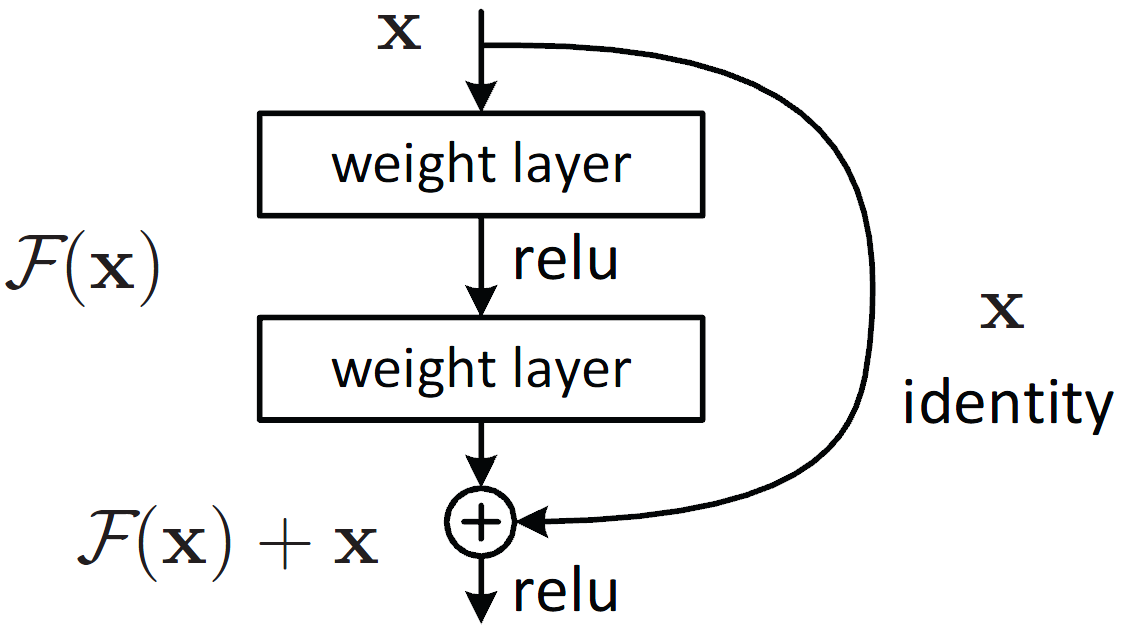
This way, there is a direct connection from the original inputs to even the deepest layers in the network.
Intended uses & limitations
You can use the raw model to classify images along the 1,000 ImageNet labels, but you can also change its head to fine-tune it on a downstream task (another classification task with different labels, image segmentation or object detection, to name a few).
How to use
You can use this model with the usual factory method in timm:
import PIL
import timm
import torch

model = timm.create_model("sgugger/resnet50d")
img = PIL.Image.open(path_to_an_image)
img = img.convert("RGB")

config = model.default_cfg

if isinstance(config["input_size"], tuple):
    img_size = config["input_size"][-2:]
else:
    img_size = config["input_size"]

transform = timm.data.transforms_factory.transforms_imagenet_eval(
    img_size=img_size,
    interpolation=config["interpolation"],
    mean=config["mean"],
    std=config["std"],
)

input_tensor = transform(cat_img)
input_tensor = input_tensor.unsqueeze(0)
# ^ batch size = 1
with torch.no_grad():
    output = model(input_tensor)

probs = output.squeeze(0).softmax(dim=0)
Limitations and bias
The training images in the dataset are usually photos clearly representing one of the 1,000 labels. The model will probably not generalize well on drawings or images containing multiple objects with different labels.
The training images in the dataset come mostly from the US (45.4%) and Great Britain (7.6%). As such the model or models created by fine-tuning this model will work better on images picturing scenes from these countries (see this paper for examples).
More generally, recent research has shown that even models trained in an unsupervised fashion on ImageNet (i.e. without using the labels) will pick up racial and gender bias represented in the training images.
Training data
This model was pretrained on ImageNet, a dataset consisting of 14 millions of hand-annotated images with 1,000 categories.
Training procedure
To be completed
Preprocessing
The images are resized using bicubic interpolation to 224x224 and normalized with the usual ImageNet statistics.
Evaluation results
This model has a top1-accuracy of 80.53% and a top-5 accuracy of 95.16% in the evaluation set of ImageNet
BibTeX entry and citation info
@article{DBLP:journals/corr/HeZRS15,
  author    = {Kaiming He and
               Xiangyu Zhang and
               Shaoqing Ren and
               Jian Sun},
  title     = {Deep Residual Learning for Image Recognition},
  journal   = {CoRR},
  volume    = {abs/1512.03385},
  year      = {2015},
  url       = {http://arxiv.org/abs/1512.03385},
  archivePrefix = {arXiv},
  eprint    = {1512.03385},
  timestamp = {Wed, 17 Apr 2019 17:23:45 +0200},
  biburl    = {https://dblp.org/rec/journals/corr/HeZRS15.bib},
  bibsource = {dblp computer science bibliography, https://dblp.org}
}